

 Massachusetts Health & Hospital Association
INSIDE THE ISSUE
> Turning 340B on Its Head
> A Discussion With Neal
> House Budget Amendments
> Kennedy on the Hot Seat
> Correction
MONDAY REPORT
MHA to HRSA: 340B Rebate Program Introduces Insurmountable Burdens
Massachusetts hospitals pushed back against yet another threat to ensuring access to sustainable patient care last week, sending detailed feedback to the federal Health Resources and Services Administration (HRSA), urging it to scrap a 340B pilot program that MHA says puts hospitals and health centers at risk.
340B is the bipartisan federal program that is a vital element of the commonwealth’s healthcare safety net, enabling hospitals and community health centers to manage rising prescription drug costs while reinvesting savings directly into patient care at no additional cost to taxpayers. It requires pharmaceutical manufacturers to sell outpatient drugs at discounted prices to healthcare organizations that care for uninsured and low-income patients.
These savings help offset the high cost of pharmaceuticals, sustain and expand essential health services, support workforce investments, and fund a wide range of community benefit programs.
The rebate program flips the traditional 340B discount program on its head by replacing upfront discounts with a post-dispensing rebate. It requires health systems to buy specific drugs at full cost, then go through an administrative process to submit claims in hopes of receiving a rebate back to the 340B ceiling price.
“MHA is deeply concerned that any rebate-based approach would impose substantial financial and operational burdens on already strained Massachusetts hospitals, diverting critical resources away from essential services and patient care,” wrote MHA’s Vice President of Federal Affairs and Strategic Initiatives Amy Bianco, echoing the alarm from 340B-eligible hospitals around the country. “… The proposed 340B Rebate Model Pilot would fundamentally alter how 340B benefits are accessed by placing manufacturers in the position of deciding whether – and when – to approve rebate payments. This shift exposes hospitals to severe financial uncertainty, as they would be required to front the full cost of drugs at levels far higher than current 340B prices or negotiated non-340B rates. Hospitals are especially concerned about their ability to absorb these upfront costs while awaiting a rebate determination controlled entirely by the manufacturer, which would retain the financial benefit of holding the funds during the review process.”
MHA’s letter to HRSA Administrator Thomas Engels was in response to the agency’s Request for Information on the rebate program. MHA detailed the administrative costs and additional staff that would be needed to create new systems to handle the rebates, as well as the delayed reimbursements that would result from destabilizing the existing 340B program.
“The cumulative effect would be reduced access to care, particularly for low income and rural patients,” MHA’s Bianco wrote. “With hospital operating margins already negative or razor thin, hospitals would be forced to offset upfront drug costs and rebate losses through staffing reductions, program cuts, and delayed or foregone investments in facilities, technology, and workforce development. That is a reality that no one wants to see play out.”
In Massachusetts, hospitals and community health centers are standing together to prevent further erosion of the 340B program. A panel of experts recently briefed local policymakers to explain how 340B represents a make-or-break choice between pharmaceutical profits and sustainable care services.
A “Fireside Chat” with Representative Neal
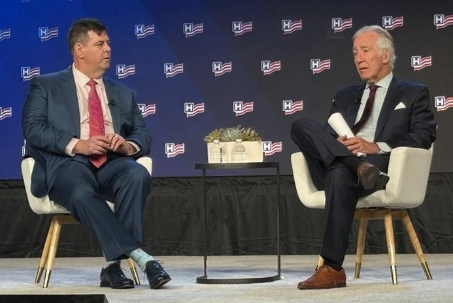
The American Hospital Association held its annual meeting in Washington, D.C. last week and one of the presentations before the 1,000-plus attendees featured a talk between the Ranking Member of the House Ways & Means Committee Richard Neal (D-Mass.) and MHA President & CEO Steve Walsh.
Neal chaired Ways & Means when Democrats controlled the House and could reprise that role if Republicans cannot hold on to their slim majority come November.
Described by his peers as a nuts-and-bolts legislator who understands, and enjoys, the details of the legislative process, Neal has always been a strong supporter of hospital and healthcare interests in Massachusetts and nationally.
Much of Walsh’s talk with Neal – and much of the AHA meeting – was focused on the question of affordability and how to keep reforming the system to make it function well for patients and caregivers in the coming years.
“We are going to have to design a better long-term healthcare system, which you’re going to be a part of,” Neal told the crowd. “And I hope we can do that with the same enthusiasm that [President] Johnson sold Medicare and Medicaid to the American people. I don’t think that we should retreat; we should advance.”
Reflecting on the current political dynamics in D.C. and nationally, Neal advocated for a substantive approach to resolve the problems facing the nation. He said, “I think that this great challenge that we’ve had, where we did these spectacular things during the pandemic by getting people the access to healthcare that they needed. It’s a pretty extraordinary story. And I wish that in the attention economy in which we live – where everything is about eyeballs rather than substantive achievement and legislative life – I hope people have the chance to perhaps, whether through doctoral dissertations or others means, to highlight what we did with the pandemic and the role that Medicare and Medicaid played during the pandemic. And now the role that telehealth is about to play.”
MHA Submits Priority Amendments Before This Week’s Budget Debate
Debate begins this week on the Massachusetts House Ways & Means proposed FY2027 state budget – a $63.3 billion spending bill that is a $2.3 billion increase over the FY2026 budget but $29 million less than what Governor Healey proposed in her H.2. budget in January.
Since Ways & Means released the budget on April 15, MHA has combed through it, highlighting its strengths and working with its membership to identify where the budget could be improved through amendments.
Last week, nine priority amendments were filed with MHA’s support, including, among other items:
- Having public and commercial insurers support alternative (non-emergency) transportation for behavioral health patients [sponsored by Rep. Daniel Cahill (D-Lynn)];
- Bolstering the reserves in the Health Safety Net Fund that is expected to once again run a nine-digit deficit this year, which is shouldered solely by hospitals [Rep. John Lawn, Jr (D-Watertown)];
- Making corrections to a previously approved funding formula for the Centers for Health Information & Analysis and the Health Policy Commission to allow pharmaceutical manufacturers to be assessed for part of the agencies’ budgets [Rep. Sean Reid (D-Lynn)];
- Creating a legal process for making healthcare decisions for adults who become incapacitated without a valid health care proxy or advance directive [Rep. Sally Kerans (D-Danvers)]; and
- Aligning coverage requirements of behavioral health crisis services with how these services are delivered under the reforms made by the Roadmap for Behavioral Health Reform [Rep. Marjorie Decker (D-Cambridge)].
“These amendments hold the promise of improving the state’s healthcare system and the lives of patients,” said Emily Dulong, MHA’s vice president of government advocacy and public policy. “We’re grateful for the representatives who have stepped up to introduce these supports and are hopeful they will spotlight important healthcare issues during this week’s budget process.”
Mass. Delegation Grills Secretary Kennedy
U.S. Health & Human Services Secretary Robert Kennedy appeared before Congress last week to defend the proposed 12% funding cut to his agency’s budget, saying the cuts were painful but necessary to trim the national deficit.
Kennedy repeatedly came under fire, especially from the members of the Massachusetts delegation, all Democrats, that sit on the House and Senate committees before which he testified. He also received criticism from some Republicans, such as Louisiana Senator Bill Cassidy, a doctor, who told Kennedy at a Senate Finance Committee hearing, “I am a doctor who has seen people die from vaccine preventable diseases. And when I see outbreaks numbering in the thousands and people dying once more from vaccine preventable diseases, particularly children, it seems more than tragic.”
Kennedy declined to take responsibility (“It has nothing to do with me,” he said) for the uptick in measles across the U.S., noting that there have been similar measles increases in Canada, the United Kingdom, and Mexico. And he supported the Pentagon’s rollback of the requirement that service personnel get the flu vaccine. “[Defense] Secretary [Pete] Hegseth was just recognizing that these soldiers being sent over to fight for our freedoms and that they should have some freedom too,” Kennedy told the Senate Health, Education, Labor, and Pensions Committee. He claimed that the flu vaccine is only 20% effective; the Centers for Disease Control and Prevention (CDC) pegs the effectiveness of the seasonal flu vaccine over the past two seasons at 56% and 36%, respectively.
Speaking before the Senate Finance Committee, on which Massachusetts Senator Elizabeth Warren (D) is a member, Kennedy defended the president’s TrumpRx portal, which is intended to lower drug prices for consumers. Warren called TrumpRx a scam, saying, “There is a more than one in four chance that Trump’s discount is actually a price hike. And for an anti-big pharma guy, you sure don’t seem worried about steering patients to more expensive drugs that are going to pad Big Pharma’s profits.” Kennedy said the site offers lower prices for brand-name drugs although even the portal concedes that those with insurance may have even lower co-pays than TrumpRx can offer.
Massachusetts Rep. Laurie Trahan (D), a member of the House Energy & Commerce Committee, which Kennedy testified before, was critical of the administration’s failure to extend Enhanced Premium Tax Credits for Affordable Care Act plans, which has resulted in people losing health coverage. “More uninsured patients means more strain on hospitals, fewer services and higher costs for everyone,” Trahan said. “It makes care more expensive, harder to access, and weakens our healthcare infrastructure. That’s not making America healthy again.”
Correction
Last week’s Monday Report contained an error in our story about the House Ways & Means’ FY2027 budget proposal as it relates to the budget of the Center for Health Information & Analysis (CHIA). The proposed House budget for CHIA (4100-0060) is $32,001,638, or roughly $920,000 less than what the governor proposed in her H.2 budget.