

 Massachusetts Health & Hospital Association
INSIDE THE ISSUE
> Healey on Healthcare Affordability
> New Series: State Directed Payments
> Work Requirement Resources
> ICE in Hospitals
> Maternal Morbidity
> The Importance of Guardianships
> AGs File Suit Over ACA
> Transition at Tufts
MONDAY REPORT
Governor Releases Healthcare Affordability Plan
After creating a Healthcare Affordability Working Group earlier this year and directing it to act quickly to devise solutions to rising healthcare costs, Governor Maura Healey during a press conference at Cape Cod Hospital last Monday released the group’s list of initial recommendations. Also on Monday, the governor signed an executive order directing MassHealth to increase its investments in primary care to 12% of total medical spending by the end of 2028.
The outline that the governor released is wide-ranging in the areas of the healthcare system it touches. She directed state agencies to come together to leverage their purchasing power to reduce the costs of medications, and gives the Group Insurance Commission the authority to “set standards” on hospital costs – although the specific steps the GIC would take to accomplish this goal were not specified.
“The cost of healthcare is putting too much pressure on families, employers and our entire healthcare system,” said Healey in a release accompanying the announcement. “These recommendations give us a roadmap to lower costs, strengthen our workforce, and make sure people can continue getting the high-quality care they deserve.”
The governor also echoed the concerns of many healthcare stakeholders, including MHA, who have noted how federal policies are adversely affecting states’ affordability agendas. For example, The One Big Beautiful Bill Act (OB3) is cutting nearly $1 trillion out of the Medicaid program.
The affordability package attempts to limit how much patients pay for care from out-of-network providers, and directs the Division of Insurance to “evaluate bold, new strategies to strengthen competition and reduce premium costs in the merged market.” It addresses transitions of care, including modernizing surrogate decision-making (see story below), and sets up a new committee to look into ways of eliminating the use of low-value care. Healey also proposes workforce investments, guidelines on the use of AI in healthcare, and enhancing existing health information exchange systems to lower costs and ensure better care.
MHA applauded the administration’s collaborative approach, while underscoring the important balance that today’s healthcare environment requires.
“Like states across the nation, Massachusetts faces an increasingly complex challenge: improving affordability for patients while protecting the fragile healthcare system and care those patients rely on every day,” MHA’s President & CEO Steve Walsh said. “We can only strike that balance and find sustainable solutions through sector-wide partnership, and we are grateful for the renewed urgency the Healey-Driscoll administration has brought to these issues over the past year. Our hospitals and health systems look forward to being a strong resource for state leaders as they work through these recommendations.”
Connecting the Symptoms Series: State Directed Payments
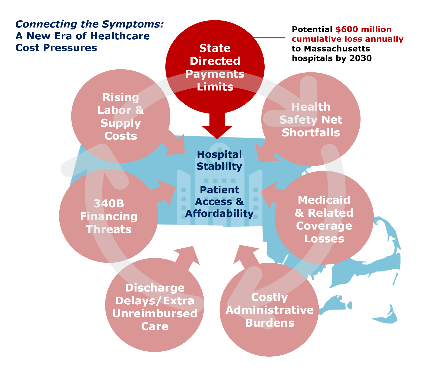
A caregiver assessing a patient usually looks beyond a single condition or symptom to address the person’s physical, mental, social, and emotional wellbeing. They treat the entire person. Now, as the state and diverse stakeholders attempt to improve the Massachusetts healthcare system to make it more stable and affordable, it becomes critical to look at the complete – and quickly evolving – spectrum of challenges facing hospitals and health systems. Massachusetts hospitals are confronting an unprecedented convergence of federal and state financing pressures that will further threaten their ability to continue providing essential services to patients and communities across the commonwealth.
The enactment of the One, Big, Beautiful Bill Act (OB3), anticipated reductions in State Directed Payments, new federal constraints on Medicaid financing mechanisms, changes to Section 1115 budget neutrality requirements, the expected loss of health coverage for hundreds of thousands of Massachusetts residents, and steadily increasing supply and labor costs collectively represent the most significant assault on healthcare financing in history. The cumulative effect of each financial condition, some of which have yet to be explored in the public eye, will leave billions of dollars hanging in the balance for the healthcare system in the coming years, and will ultimately affect care for Massachusetts residents. Over the coming weeks, Monday Report will explore various parts of the collective financial whole.
State Directed Payment Limits
OB3, which was signed into law in 2025, cuts more than $900 billion of federal Medicaid spending from 2025 through 2034 – and much of those cuts come from restrictions on Medicaid State Directed Payments (SDPs). Massachusetts, like other states, is now bracing for major reductions to this funding source.
Since 2016, states have been allowed, through SDPs, to direct how Medicaid managed care organizations reimburse healthcare providers under certain conditions. Using SDP provisions, states can require uniform rate increases for a class of providers such as safety net hospitals, or can require the plans to make quality incentive payments to providers. Massachusetts’ use of SDPs over the years has helped stabilize safety net hospitals and has improved care quality for MassHealth patients.
OB3 limited that financing mechanism and in doing so will remove $200 million a year from Medicaid federal reimbursements beginning in 2028, resulting in a cumulative loss to hospitals of $600 million annually by 2030. The major reason for the massive losses is the federal government’s decision to limit state directed payments to ensure the reimbursement from managed care plans does not exceed 100% of the Medicare rate. The current reimbursement rate in Massachusetts and other states is pegged at the average commercial rate, which is higher than Medicare.
“If hundreds of millions of federal dollars – used primarily to help safety net hospitals – are removed from the Massachusetts healthcare system, then those hospitals will be irreparably harmed,” said Dan McHale, MHA’s senior vice president of healthcare finance and policy. “Their destabilization will occur at a time when the Health Safety Net program, on which they also heavily rely, is severely underfunded and when hundreds of thousands of residents are expected to lose coverage as a result of OB3’s Medicaid work requirements and other requirements.”
MHA has stressed that these individual policy and funding pressure points are interconnected and need to be considered holistically as opposed to individually in order to keep the healthcare system functioning for patients in the near future.
State government is currently working to create a new Section 1115 waiver proposal – that is, the five-year agreement between the state and federal government on how the state’s MassHealth program will be financed and operate. MHA, which has been working closely with the state on the waiver, has asked the Executive Office of Health and Human Services to treat mitigation of anticipated SDP losses as one of the principal objectives of the next agreement.
Medicaid Work Mandates: Resources and Webinars from MassHealth

As has been reported (see story above), massive Medicaid changes are expected to disrupt the local and national healthcare system in the coming months and years. For example, changes to eligibility for certain immigrants will start in October.
Another sweeping change that will go into effect January 1 is the work or “community engagement” mandate that requires most Medicaid recipients to work or pursue other approved activities for a minimum number of hours per month to be eligible for benefits.
The state’s Medicaid program, MassHealth, along with patient advocates, hospitals, and other providers are preparing for the significant administrative challenges required to inform enrollees of the new mandates and then to track and report their fulfillment of them.
MassHealth recently released this screener tool to help individuals determine if they are affected by new requirements. This communications toolkit in various languages informs MassHealth members of the new requirements and how it may affect them. And this signup link allows anyone, especially those with connections to affected populations, to receive regular e-mail updates on the changes. All of these materials, as well as other resources are contained on this webpage MassHealth launched, which will be updated on a rolling basis.
MassHealth has scheduled a webinar outlining the latest information on coming policy changes and how it is supporting members and partners. The webinars will explain which MassHealth members will be affected, the state’s timeline for notifying affected members, and its statewide strategy to support members and partners through these new processes.
The following two webinars contain the same content; interested individuals are asked to choose one of the two dates.
- Tuesday, August 25 at noon. Register here.
- Thursday, September 10 at 2 p.m. Register here.
MHA, like advocates in other states, has consistently raised concerns about the Medicaid work requirements, most recently sending this letter to U.S. Health and Human Services and the Centers for Medicare and Medicaid Services.
Protect Act Restricts ICE in Hospitals
Last Wednesday, Governor Maura Healey signed the POTECT Act, which among things, prevents U.S. Immigration and Customs Enforcement (ICE) from conducting warrantless immigrant arrests at courthouses, schools, childcare centers, and healthcare facilities, including hospitals, community health centers and nursing homes. To make an arrest in such spaces, ICE agents will need a judicial warrant.
“In my work as a clinician, I’ve seen firsthand how important it is to maintain a safe, healing environment in our hospitals,” said Health and Human Services Secretary Kiame Mahaniah, M.D. “Keeping ICE out of hospitals, as well as our courthouses and schools means we also keep fear out of these places.”
The new state law was touted by the Healey-Driscoll administration as the strongest in the nation against ICE. The PROTECT Act passed the Massachusetts House in March and the Senate in May.
State Maternal Mortality Report Shows Stark Disparities
DPH recently released a report based on the work of the state’s The Maternal Mortality and Morbidity Review Committee, which uses various data sources to identify deaths of people while pregnant or within a year of the end of a pregnancy.
The report shows that between 2019 and 2023 there were 69 pregnancy-related deaths, meaning the death occurred within one year of pregnancy, from a pregnancy complication, a chain of events triggered by the pregnancy, or the aggravation of an unrelated condition caused by the pregnancy. Pregnancy-related deaths are counted among the 153 pregnancy-associated deaths that occurred over the same period and are defined as deaths during or within one year of pregnancy, regardless of the cause.
The overall pregnancy-related mortality ratio (PRMR), defined as the number of pregnancy-related deaths per 100,000 live births, was 20.3, but there were striking racial and ethnic inequities in maternal mortality. The PRMR was over twice as high for Black non-Hispanic people (41.8) as for White non-Hispanic people (17.9) and for Hispanic people (13.7).
More than half (60%) of the 69 pregnancy-related deaths occurred from seven days after end of pregnancy to one year after the end of pregnancy. Mental health conditions contributed or probably contributed to 41% of pregnancy-related deaths, while substance use disorder contributed or probably contributed to more than half (45%) of pregnancy-related deaths. Lack of care continuity and coordination contributed to 22% of pregnancy-related deaths.
New Report Focuses on Importance of Guardianships
As has been shown in MHA’s monthly throughput reports, up to 2,000 patients are regularly “stuck” in acute care hospitals unable to transition to the next level of care in a post-acute facility or home care environment. The reasons for the stalled discharges vary, but a persistent reason is that some patients not only lack the capacity to make their own medical decisions, but they also lack a surrogate decision maker to make the choices for them. Such unrepresented individuals then must have guardianship plans created for them through the courts – a lengthy process that keeps patients from receiving the post-acute hospital care they need and keeps acute care beds tied up for others.
A new report from DPH, conducted in collaboration with Eastern Research Group, explored the need and feasibility of qualified professional guardians in Massachusetts to reduce hospital discharge issues and increase access to long-term care and preventive care.
“As a result of the study, DPH finds there is a significant need for qualified professional guardians to give informed medical consent for persons who are unable to afford these services otherwise and that increasing payment to Qualified Professional Guardians, coupled with other recommended legislative changes, could substantially reduce delays in hospital discharges and expedite access to long-term and preventative care,” according to the report.
As for recommendations to resolve the problem, the report states, “The optimal solution for reducing acute-care hospital discharge delays is to increase the pool of qualified Guardians, and to do this, interviewees and literature indicate that it will be necessary to pay them.” There is no federal program from which to seek reimbursements for such payments, so reimbursement would have to come from the state, the report found.
Governor Healey in her healthcare affordability recommendations released last week (see story above) referred specifically to the 2,000 patients that regularly await discharge from acute care hospitals. The administration said that as part of its affordability focus, it “will explore action to modernize surrogate decision-making and healthcare proxy laws.” Both of those recommendations were cited in this report, which also recommended promotion of the MHA/Honoring Choices/DPH Simple Step Campaign to encourage residents to designate healthcare proxies. These recommendations were also included in the Transitions from Acute Care to Post-Acute Care Task Force report that was submitted to the legislature in July 2025; MHA served on that task force.
AGs File Yet Another Suit Over ACA
A group of 21 Democratic state Attorneys General, including Massachusetts AG Andrea Campbell, along with Pennsylvania Governor Josh Shapiro have filed suit against the federal government alleging that new rules governing enrollment into the Affordable Care Act marketplace did not follow proper rulemaking steps and will lead to millions of people losing coverage.
While the administration argues it is attempting to improve the ACA and make it more efficient, the AGs argue that U.S. Health & Human Services (HHS) and the Centers for Medicare and Medicaid Services (CMS) – the suit’s defendants – are merely attempting to scuttle the ACA, which has existed since 2010 but has been consistently criticized by the Trump administration.
Specific to State of California et al v. Kennedy et. al. filed on July 31 is the claim that HHS and CMS are creating annual out-of-pocket spending limits for “Bronze” plans above the ACA limits, in effect exposing patients to massive potential costs. The Democratic states also claim that by making it harder to enroll in plans due to heightened income verification and mandatory auditing, low-income individuals will lose coverage. Primarily, the plaintiffs claim that many of the arguments they make in the suit already have been decided in their favor through a previous suit filed against an earlier iteration of the federal rules. That previous case, as well as the present case, allege that HHS and CMS violated the Administrative Procedure Act in crafting the rule.
Transition
Tufts Medicine President & CEO and MHA Board of Trustees member Michael Dandorph has announced that he will be stepping down from his role, effective September 30. Dandorph has led the system since 2020. Phil Okala, the system’s current chief operating officer, will become acting president after Dandorph leaves. Also departing Tufts Medicine will be the system’s Executive Vice President and CFO Andrew DeVoe. In his role as an MHA Trustee, Dandorph provided leadership to the association on many issues, including those related to workforce development.
“Since day one of overseeing Tufts Medicine, Mike has been a committed and compassionate partner in uplifting our commonwealth’s entire healthcare system,” said MHA President & CEO Steve Walsh. “We are deeply grateful for his collaborative leadership during a time of tremendous change for Massachusetts care delivery. His contributions have touched patients and caregivers across the state – particularly through his role as co-chair of MHA’s Workforce Leadership Task Force, which has taken bold steps to support and grow the caring profession.”