

 Massachusetts Health & Hospital Association
INSIDE THE ISSUE
> Neal on State Directed Payments
> New Finance Series: The RFA
> DOI Affordability Sessions
MONDAY REPORT
Neal Joins Chorus of Criticism Against Federal SDP Rule
U.S. Representative Richard Neal (D-Mass.), the ranking member of the House Ways Means Committee, has written to the Centers for Medicare and Medicaid Services (CMS) objecting to its proposed rule that would change Medicaid State Directed Payments (SDPs), resulting in financial losses for hospitals across the United States.
For the past 10 years, states have been allowed through SDPs to direct how Medicaid managed care organizations reimburse healthcare providers under certain conditions. Using SDPs, states can require uniform rate increases for a class of providers such as safety net hospitals, or can require the managed care plans to make quality incentive payments to providers. Massachusetts’ use of SDPs over the years has helped stabilize safety net hospitals and has improved care quality for MassHealth patients.
Under the One Big Beautiful Bill Act (OB3), and the proposed CMS regulation implementing OB3, that SDP financing mechanism is limited and will require 10% annual reductions, which MHA has estimated will remove $200 million a year from Medicaid federal reimbursements beginning in 2028, resulting in a cumulative loss to Massachusetts hospitals of $600 million annually by 2030. Hospitals across the U.S. will experience similar 10% annual losses. The revenue loss in Massachusetts is just one of many financial hits to the healthcare sector scheduled to go into effect in the coming years (see story below).
“Unquestionably, this rule makes a flawed law [OB3] even worse,” Neal wrote to CMS Administrator Dr. Mehmet Oz. “If finalized as proposed, the rule would further destabilize state Medicaid programs and lead to significant reductions in payments to providers.”
Neal noted that states have “long under-invested in Medicaid provider payments, and many states now use state directed payments to remedy longstanding gaps in payment that have harmed access for Medicaid enrollees.” He was especially critical of provisions in CMS’s proposed rule about applying rate limits to the state directed payments, which would result in providers that have been receiving low Medicaid reimbursements being “unable to receive critical increases in payments, resulting in diminished access to care in services and communities that are already struggling.”
MHA made similar arguments in its July letter to CMS on the issue. In asking that CMS revise the proposed rule, MHA wrote in July, “MHA acknowledges CMS’s obligation to ensure that the [Medicaid] program is implemented with integrity and in a manner that complies with federal statute. At the same time, it is vital that CMS maintain a productive and flexible relationship with local governments and healthcare providers to allow the Medicaid program to continue to innovate and sustain its decades of proven successes. Medicaid SDPs are essential components of the financing that drives these payment and delivery system reforms, funds quality incentive programs, and ensures that access to services is sustainable. In turn, SDPs allow healthcare providers and the government to deliver on their shared goal of high-quality care for every patient.”
Connecting the Symptoms: The Medicaid RFA
As the state and diverse interests attempt to improve the Massachusetts healthcare system to make it more stable and affordable, it’s important to look at the complete and quickly evolving spectrum of challenges facing hospitals and health systems.
The enactment of OB3, anticipated reductions in State Directed Payments, new federal constraints on Medicaid financing mechanisms, the expected loss of health coverage for hundreds of thousands of Massachusetts residents, steadily increasing supply and labor costs, and threats to 340B financing collectively represent a significant assault on hospital and health system financing. The cumulative effect of each financial condition, some of which have yet to be explored in the public eye, will leave billions of dollars hanging in the balance for the healthcare system in the coming years, and will ultimately affect care for Massachusetts residents. In this “Connecting the Symptoms” Series, Monday Report has been exploring the various parts of the collective financial whole. Read part two here, covering the erosion of 340B.
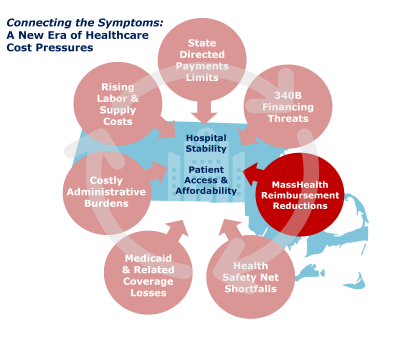
The MassHealth Acute Hospital Request for Applications (RFA) is the primary annual contractual agreement and policy framework between MassHealth and Massachusetts acute care hospitals, outlining Medicaid payment rates and operational standards for hospitals caring for MassHealth patients. The 2027 rate year RFA is expected to be released by the end of August, and will be effective October 1.
In response to MassHealth’s proposals that the state has previewed with hospitals over the past many months, MHA has warned that numerous changes in those proposals will challenge healthcare access and increase administrative burden, which will be especially problematic to hospitals and health systems given the other coverage losses and federal changes expected in the coming months and years.
Of great concern, the Executive Office of Health and Human Services (EOHHS) proposes eliminating hospital reimbursement for telehealth medical visits, while maintaining reimbursement for physician and community health center telehealth visits. Hospitals are currently reimbursed for telehealth services, which supports their expenses for the care delivery team providing the services to MassHealth patients, the ongoing costs of maintaining a virtual infrastructure, ensuring that providers have secure platforms that are HIPAA-compliant, and the costs for software licenses, IT support, and language interpreters. Additionally, this reimbursement supports the staff who schedule appointments and conduct follow-up care, including referrals and other EHR documentation. If the funding is cut, access to telehealth care for patients facing transportation issues, geographic barriers, or work scheduling issues will be disrupted, MHA has argued.
In the rate year 2027 RFA, EOHHS is anticipated to propose a post-payment utilization review for outpatient claims – introducing an added layer of administrative red tape for services that have already been provided, similar to practices used by many commercial payers that hospitals have challenged. EOHHS has assumed budgetary savings from the post-hospitalization reviews; MHA points out the very great possibility for a very large administrative burden that requires diverting clinical staff away from patients and towards documenting and appealing claims.
Another concern with the proposed RFA is the “72-Hour Rule” in which EOHHS proposes to bundle related outpatient services – including those provided in the emergency department (ED) or through observation status – into the inpatient payment if the care is provided within three calendar days. A concern is that resources provided during an ED visit will be unreimbursed despite appropriate efforts to treat, stabilize, and discharge the patient and record the encounter.
“The proposed set of RFA policies run counter to statewide goals to support primary care and healthcare access, and to reduce administrative burden,” said Dan McHale, MHA’s senior vice president of healthcare finance and policy. “The very granular details of the RFA that we expect to be released shortly all coalesce into a very real wave of administrative burdens and reimbursement cuts that come at the worst possible time for hospitals and health systems. We remain hopeful that MassHealth will reconsider these proposals given our shared goals of promoting healthcare access and reducing administrative burden, especially given the severe Medicaid challenges in the years ahead.”
DOI Sets Listening Sessions for Affordability Discussions
On August 3, the Healey-Driscoll administration announced a package of 12 broad actions focused on healthcare affordability. The initial set of actions will serve as the starting point for further discussions with diverse interests about how to drive down costs through reform of the health system.
As part of the effort, Governor Healey directed the Division of Insurance (DOI) to develop regulations to (1) reduce the costs of out-of-network charges and (2) stabilize the health insurance market for small businesses and individuals to reduce premium costs. To inform the regulatory process, DOI is holding a series of six virtual listening sessions prior to drafting regulations.
The September, October, and November dates and log-in information for the out-of-network costs sessions are here, and info on the stabilizing the market sessions is here.
In the recent announcement of the 12 state actions, the governor noted that she is directing DOI to establish default out-of-network payment rates to “protect against surprise billing and reduce overall costs across the market.” As for stabilizing the market, the directive was more general, noting that Healey has directed DOI “to evaluate bold, new strategies to strengthen competition and reduce premium costs in the merged market.”