

 Massachusetts Health & Hospital Association
 Can Hospitals Continue to Support the Safety Net?
INSIDE THE ISSUE
> Rural Health Transformation Program
> Finance Series: The Health Safety Net
> $100,00-plus for H-1B
> Hospital News
MONDAY REPORT
Rural Health Transformation Program Ramping Up
The Massachusetts Rural Health Transformation Program (RHTP) is moving full steam ahead — transitioning from planning to designing the ways to use the $162 million that Massachusetts is receiving in year one of the program. Recent stakeholder sessions and ongoing initiative workgroups are helping shape the state’s five-year plan.
Governor Maura Healey recently announced the appointment of the RHTP Community Advisory Council. MHA has a seat on the council to share the perspective of hospitals serving rural communities across the state. The council’s role is to provide community expertise and guidance to the state’s team while maintaining a fair and transparent funding process. The council will provide recommendations to the state regarding program priorities; community outreach and engagement; accessibility and inclusion; and program evaluation. It will not score grant applications, rank applicants nor make direct funding decisions.
The council has recently conducted orientation sessions in anticipation of its first meeting for its members to understand the background regarding the state of rural health in Massachusetts; review the RHTP plan and the proposed initiatives in the program; outline the Center for Medicare and Medicaid Services’ (CMS’) continued funding requirements; and delineate the council’s responsibilities and governance model. The Rural Health Transformation Program is operated by the Executive Office of Health and Human Services (EOHHS) and led by EOHHS Director of Strategic Health Initiatives Eliza Lake and Program Director of the Rural Health Transformation Program Kirby Lecy.
Connecting the Symptoms: The Health Safety Net
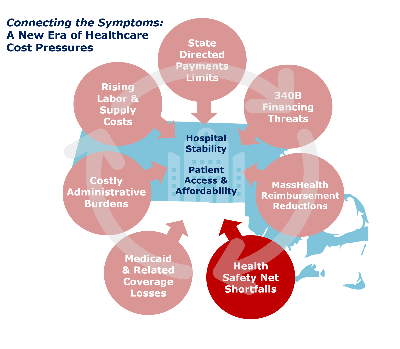
As the state and diverse interests attempt to improve the Massachusetts healthcare system to make it more stable and affordable, it’s important to look at the complete and quickly evolving spectrum of challenges facing hospitals and health systems.
The enactment of the One Big Beautiful Bill, anticipated reductions in State Directed Payments, new federal constraints on Medicaid financing mechanisms, the expected loss of health coverage for hundreds of thousands of Massachusetts residents, steadily increasing supply and labor costs, and threats to 340B financing collectively represent a significant assault on hospital and health system financing. The cumulative effect of each financial condition, some of which have yet to be explored in the public eye, will leave billions of dollars hanging in the balance for the healthcare system in the coming years, and will ultimately affect care for Massachusetts residents. In this “Connecting the Symptoms” Series, Monday Report has been exploring the various parts of the collective financial whole. Read part three here, covering the MassHealth Acute Hospital Request for Applications (RFA).
The Frayed Health Safety Net
The Health Safety Net (HSN) pays hospitals and health centers for care provided to patients who are uninsured and underinsured. It is funded annually by a $165 million assessment on both hospitals and health insurers and $15 million in state funding. In nearly every year since its establishment in 2006, the Health Safety Net fund has run a deficit, meaning the cost of care to those it serves exceeds the money from the hospital-insurer-state assessment. By statute, hospitals alone bear the shortfall in funding. Those shortfalls, even with recent supplemental funding from the legislature and Healey-Driscoll administration, are now running at more than $200 million a year – representing one of the most pressing financial issues for hospitals today.
State policymakers have stepped up to deliver roughly $350 million in short-term relief to the fraying safety net over the past several years. But according to the Massachusetts Taxpayers Foundation, the Medicaid coverage changes alone in OB3 would more than double the number of uninsured individuals in the state and increase HSN demand by up to $510 million. This estimate aligns closely with the modeling estimates that MHA has collaborated on with EOHHS absent programmatic changes, with uninsured demand potentially higher due to further federal restrictions. Such an upward spike in HSN demand will place what MHA has termed “unsustainable” pressure on hospitals and health systems.
“In effect, hospitals alone are now financing the growing cost of care provided to low-income uninsured residents in local healthcare settings – an unsustainable equation with very real implications for patient access,” said MHA’s Senior Vice President of Healthcare Finance and Policy Dan McHale. “The long-term viability of the program depends upon establishing a sustainable financing strategy that recognizes both the anticipated growth in uncompensated care and the broader reductions in Medicaid financing that hospitals will experience over the next several years.” Those broader reductions in financing include the changes to State Directed Payments that will result in substantial reductions in Medicaid supplemental payments to hospitals.
“These financing challenges cannot be viewed independently,” McHale said. “Rather, they require a coordinated financing strategy that recognizes the cumulative impact of multiple federal policy changes on hospitals serving low-income patients.”
Potential funding sources that could help rescue the current HSN, according to a proposal MHA has floated, include taking advantage of the savings the state itself will experience when Medicaid enrollment decreases due to OB3. Such funding reverting to the General Fund should “follow the patient” and be directed to the HSN, MHA has proposed. Another funding plan involves continuing what the governor and legislature opted to do this fiscal year – using interest from the Commonwealth Federal Matching and Debt Reduction Fund to help fund the safety net.
And importantly, MHA has posited, the shared responsibility for the HSN must be revisited. The insurer assessment that helps finance the Health Safety Net has remained effectively flat for nearly two decades, despite significant growth in healthcare costs and demand for services. At the same time, under the current HSN funding structure, community health centers receive priority access to HSN funding. As a result, when program funding falls short, as it consistently has in recent years, hospitals bear the financial burden.
“Change is long overdue to rebalance the share of financing the expenses of delivering care to the commonwealth’s low-income uninsured population,” McHale said. “For too long, hospitals have been the primary financer of that care to the detriment of their daily operations, even with the state recently providing needed support through ad hoc legislative relief packages.” MHA has also urged the state to not only identify new revenue sources, but also to ensure that any programmatic changes to the HSN rules do not place additional financial burdens on hospitals.
In acknowledgment of current and increasing pressures, EOHHS has engaged closely with hospitals and community health centers on potential reforms to ensure sustainability. One of the main mechanisms for supporting the state’s healthcare system as it prepares for the massive changes from OB3 and other federal policies is through the 1115 Medicaid waiver, which the state is currently drafting and will submit to CMS later this year.
“MHA believes new safety net resources must be identified as part of the commonwealth’s development of the Section 1115 waiver, which is a precious opportunity to soften the blow of future hospital losses,” McHale said. “We look forward to advocating with the state on a financing strategy that reflects the magnitude of the financial challenges now facing the program. Absent new revenues, hospital support for the HSN program will become questionable and patient services will become even harder to maintain.”
Hefty H-1B Fee Expected to Hurt Hiring
After a U.S. District Court judge in June struck down the administration’s proposal for increasing the fee for filing an H-1B petition to $100,000 (from the prior average fee of about $2,500), the Trump administration last week issued notice that it was proposing a revised fee – $103,625.
In June, Judge Leo Sorkin stated that the steep increase in the cost of the permit fee was, in effect, a new tax that exceeded the Department of Homeland Security’s (DHS’s) authority under the law. DHS now justifies the six-figure fee as necessary to “generate dedicated revenue to support the costs of administering the lawful immigration system.”
The H-1B visa is a temporary work visa that enables U.S. employers to hire non-citizen workers and provides a pathway for professionals to live and work in the United States after completing their education. The number of new H-1B visas is capped at 65,000 each year with an additional 20,000 visas for those with a U.S. master’s degree or higher. Some employers are exempt from the annual cap, including institutions of higher education, non-profit research institutions, and non-profits directly affiliated with higher ed institutions.
“The proposed $103,265 fee could lead to reductions in U.S. healthcare workforce, increasing barriers to care,” according to an analysis from KFF. That study found that “a decline in H-1B workers would disproportionately impact states that employ the largest shares of H-1B workers (NY, MA, CA, and PA), lower income and rural areas where H-1B healthcare workers often are employed, and smaller employers, who would face greater challenges paying the fee.”
Hospital News from Around the State
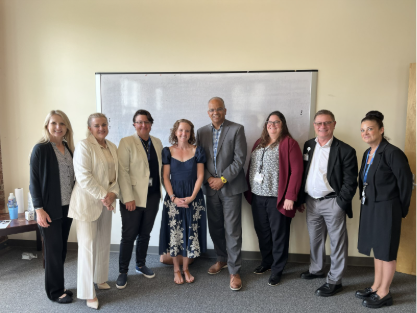
EOHHS Secretary Kiame Mahaniah, M.D., visited the Beth Israel Lahey Health Behavioral Services Community Behavioral Health Center in Lawrence last Wednesday. The visit was part of Mahaniah’s months-long “community mental health tour” across the state to highlight the administration’s investment in mental health services and raise public awareness about them. The administration also launched a campaign last week to draw workers into the behavioral health field
“In Massachusetts, we are lucky to have robust mental health services available for people of all ages,” said Department of Mental Health Commissioner Emily Bailey. “But we know there is more work to be done and communities where access remains limited. With this tour, we hope to connect more people across the state with the resources available to them.”

Cape Cod Healthcare has announced a partnership with Broad Reach Healthcare and JML Care Center.
Broad Reach Healthcare is the owner of Liberty Commons Rehabilitation and Skilled Care Center in Chatham. Located on the campus of Falmouth Hospital, JML Care Center is a 132-bed skilled nursing, long-term care and short-term rehabilitation facility, which completed a renovation in 2022. Effective September 1, Broad Reach Healthcare will assume operational management of JML Care Center, which will remain fully owned by Cape Cod Healthcare. All JML staff will continue to be employees of Cape Cod Healthcare, and there are no planned changes to the current management team in place at JML.
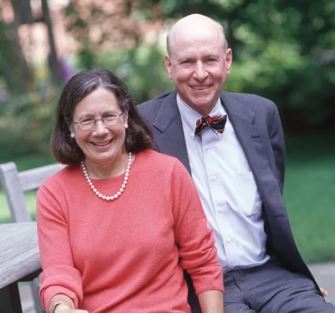
Dana-Farber Cancer Institute has received a $35 million gift from Richard K. and Nancy K. Lubin. The gift will support cancer research, early detection, survivorship, patient assistance and psychosocial services, as well as construction of the Lavine Bekenstein Cancer Hospital at Dana-Farber, a 300-bed inpatient hospital being constructed on the former site of the Joslin Diabetes Center along Brookline Avenue. The third floor of the new cancer hospital will be named after the Lubins.
Richard Lubin has been a trustee of Dana-Farber since the early 1990s. In a media release announcing the gift, the hospital wrote that the Lubin family’s philanthropy over 40 years has “aided Dana-Farber’s efforts in drug development and cancer chemical biology for skin cancer; construction of the Yawkey Center for Cancer Care, which includes the Richard and Nancy Lubin Lobby on the building’s second floor; the Richard and Nancy Lubin Family Chair at Dana-Farber; and, since 2022, the Lubin Family Foundation Scholar Award, a signature program dedicated to advancing the careers of promising early career investigators.”