

 Massachusetts Health & Hospital Association
 NEW REPORT: Massachusetts Hospitals Add 10,000 Jobs and Reduce Workforce Shortages

Hospitals report major progress in decreasing vacancies in key areas despite persistent pressures
Massachusetts hospitals have made major progress in building and strengthening the state’s healthcare workforce in recent years, according to a new report released today by the Massachusetts Health & Hospital Association (MHA).
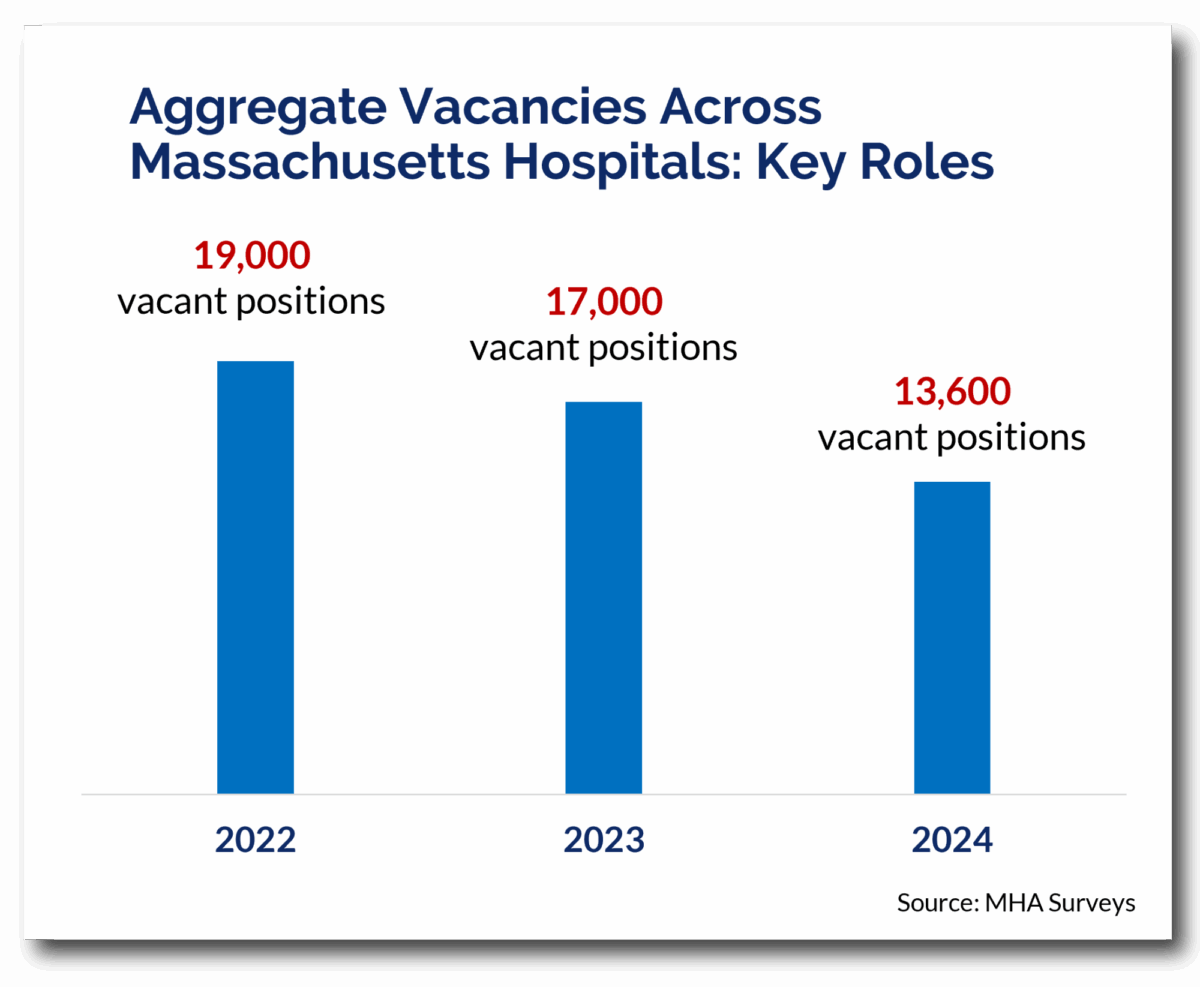
The report, On the Mend: Progress and Pressure Points for Massachusetts’ Healthcare Workforce, focuses on key clinical and support roles, all of which are essential to the delivery of timely patient care and managing system-wide costs. It shows that Massachusetts hospitals have added 10,000 jobs since 2020, helping cement the sector’s status as a leading economic engine for the state. Following MHA’s 2022 workforce report identifying 19,000 vacancies in key hospital positions across the commonwealth, On the Mend reveals that focused recruitment, hiring, and retention efforts have reduced that number to 13,600 open positions – a 28% decline.
“This is a remarkable success story — not just for healthcare, but for all of Massachusetts,” said Valerie Fleishman, executive vice president and chief innovation officer at the Massachusetts Health & Hospital Association. “Even through enormous operational challenges, our hospitals and health systems have devoted a record amount of resources to workforce in recent years. These investments have made a clear difference, and they deserve to be celebrated as a sign of our commonwealth’s success. Every one of these 10,000 new jobs improves care access for a patient, supports a local community, and provides a true livelihood for a friend or neighbor.”
Hospitals are a major source of stable, well-paying jobs and are expanding their hiring to meet the ever-rising need for care. This growth has occurred within a highly volatile financial landscape – both for the healthcare community and other sectors.
Nursing roles saw some of the sharpest improvements from 2022 to 2024. Five of the 10 largest vacancy reductions occurred in nursing positions, and the statewide nursing vacancy rate has dropped from 15% to 10%. Hospitals also report a steep decline in the use of high-cost “travel nurses” from 2023 to 2024, though temporary labor remains higher than pre-pandemic levels.
The report highlights the success of coordinated statewide actions and collaboration among hospitals, their partners, and state government. Hospitals and health systems have built new academic partnerships and training programs while expanding career ladders, increasing salaries and benefits, and expanding wellbeing programs for existing workers. State leaders have passed funding to develop the behavioral health workforce, launched free community college opportunities, and scaled up local job training programs, among other actions.
Meanwhile, MHA and its members have rallied around a set of initiatives adopted by all hospitals to prevent workplace violence, promote worker growth, and recruit people to join the healthcare field. Together, these initiatives have made hospital careers more accessible and rewarding for workers across the commonwealth.
“It’s no coincidence that the voices of nurses and caregivers have been at the heart of our recent strides,” said Nancy Gaden, DNP, RN, FAAN, senior vice president & chief nursing officer at Boston Medical Center and co-chair of MHA’s Workforce Leadership Task Force. “Through MHA’s Task Force, we have assembled an academy, removed stigmatizing questions from the credentialing process, and mounted a messaging campaign – all within the course of just a few years. We will continue to amplify the perspective of our frontline providers as we build a more resilient, supportive workplace of the future.”
Healthcare providers, however, continue to navigate persistent shortages in some patient-facing roles. The report documents the high vacancy rates still being seen among technicians, community health workers, certain behavioral health professionals, and advanced practice providers – positions that are critical to patient care.
Maintaining the momentum Massachusetts has built over the past several years will be essential to addressing remaining workforce gaps, particularly for roles that are well above the median vacancy rate of 14.2%. On the Mend outlines policy reforms, targeted statewide strategies, and training opportunities that Massachusetts can embrace with these high-need positions in mind.
The data presented in the report is derived from a survey sent to hospitals in early 2025 requesting information on 56 positions. It is worth noting that, concurrently with the uptick in hiring, certain, largely non-clinical roles have faced layoffs due to the financial pressures besetting the entire healthcare ecosystem in the commonwealth. Based on MHA’s data, the reduction in vacancy rates for these key surveyed positions (the vast majority of which are clinical or patient-facing) was primarily the result of new hires in those areas.