

 Massachusetts Health & Hospital Association
 CONNECTING THE SYMPTOMS: A New Era of Healthcare Cost Pressures
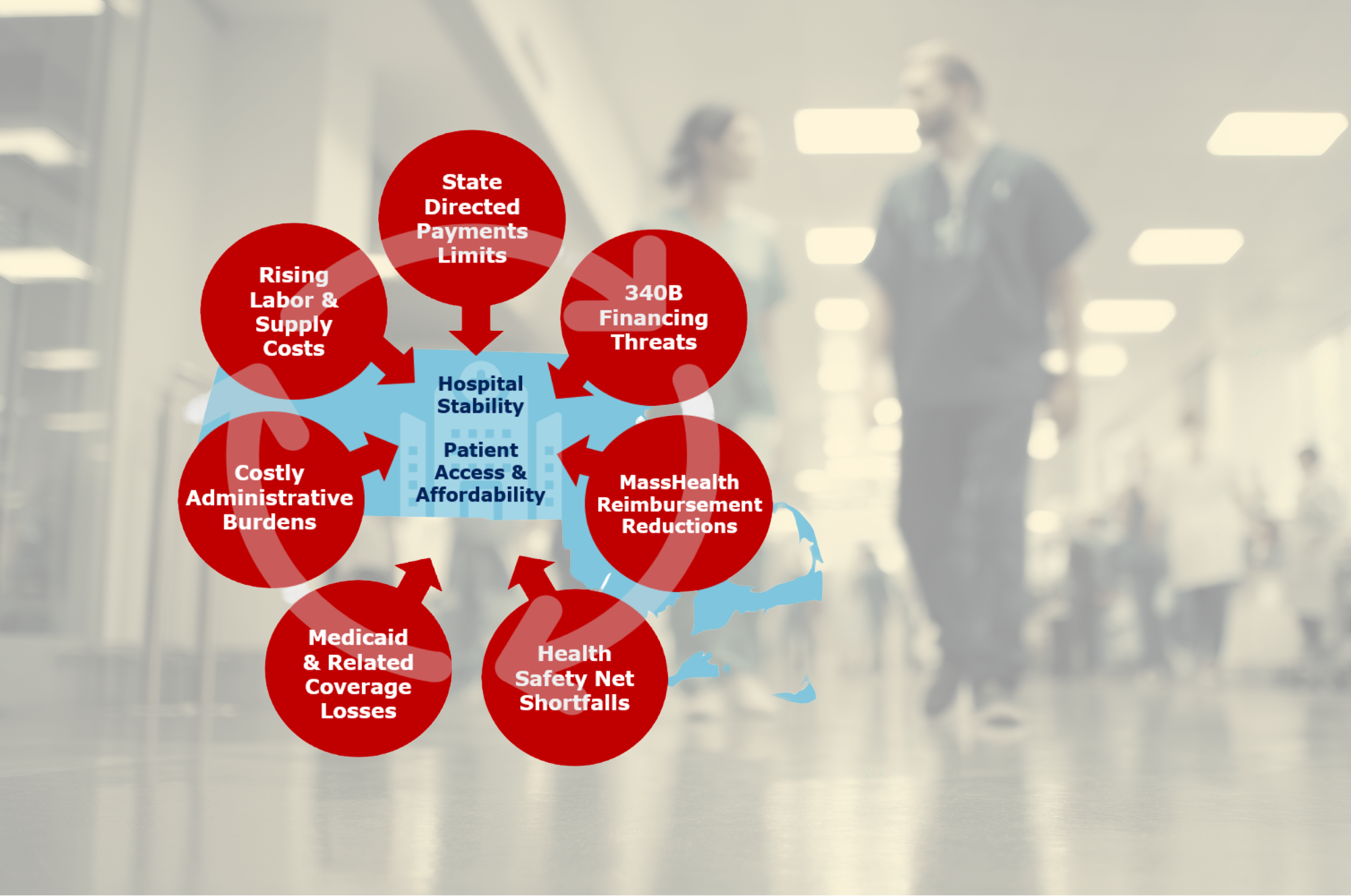
A caregiver assessing a patient usually looks beyond a single condition or symptom to address the person’s physical, mental, social, and emotional wellbeing. They treat the entire person.
Now, as the state and diverse stakeholders attempt to improve the Massachusetts healthcare system to make it more stable and affordable, it becomes critical to look at the complete – and quickly evolving – spectrum of challenges facing hospitals and health systems.
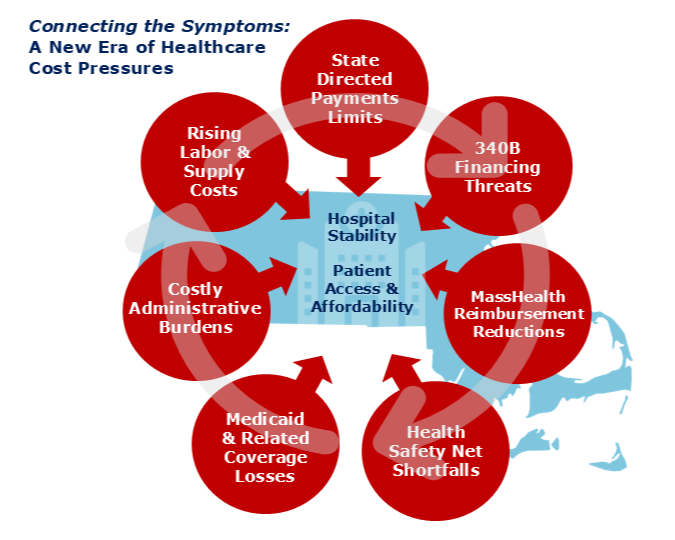
Major federal policy changes, widespread coverage losses, threats to MassHealth funding and drug affordability, and steadily increasing supply and labor costs collectively represent the most significant assault on healthcare financing in history.
The cumulative effect of each financial condition, some of which have yet to be explored in the public eye, will leave billions of dollars hanging in the balance for the healthcare system in the coming years, and will ultimately affect hospitals’ ability to continue providing essential services to patients and communities across the commonwealth.
MHA’s “Connecting the Symptoms” series highlights several of these emerging cost pressures, in an effort to inform Massachusetts’ ongoing approach to supporting its healthcare system and patients:
- State Directed Payments: $600 Million in Annual Losses
- 340B: Threats to An Essential Lifeline
- The Medicaid RFA: Access & Administrative Challenges
- The Health Safety Net: A Fraying Program
State Directed Payments: $600 Million in Annual Losses
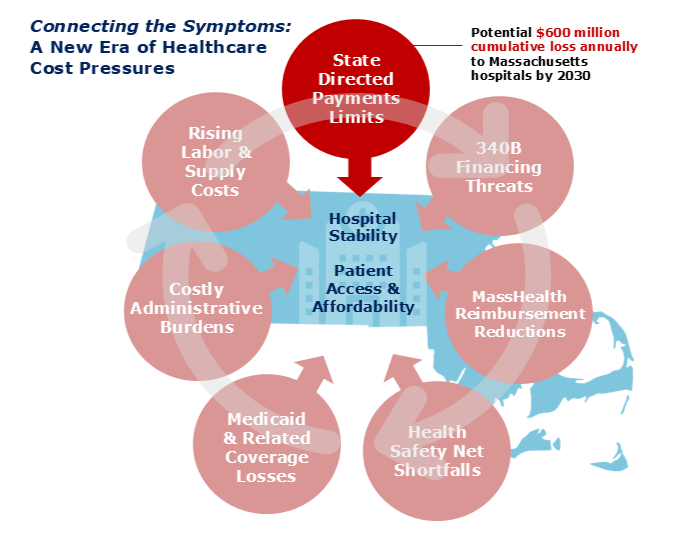
OB3, which was signed into law in 2025, cuts more than $900 billion of federal Medicaid spending from 2025 through 2034 – and much of those cuts come from restrictions on Medicaid State Directed Payments (SDPs). Massachusetts, like other states, is now bracing for major reductions to this funding source.
Since 2016, states have been allowed, through SDPs, to direct how Medicaid managed care organizations reimburse healthcare providers under certain conditions. Using SDP provisions, states can require uniform rate increases for a class of providers such as safety net hospitals, or can require the plans to make quality incentive payments to providers. Massachusetts’ use of SDPs over the years has helped stabilize safety net hospitals and has improved care quality for MassHealth patients.
OB3 limited that financing mechanism and in doing so will remove $200 million a year from Medicaid federal reimbursements beginning in 2028, resulting in a cumulative loss to hospitals of $600 million annually by 2030. The major reason for the massive losses is the federal government’s decision to limit state directed payments to ensure the reimbursement from managed care plans does not exceed 100% of the Medicare rate. The current reimbursement rate in Massachusetts and other states is pegged at the average commercial rate, which is higher than Medicare.
MHA has stressed that these individual policy and funding pressure points are interconnected and need to be considered holistically as opposed to individually in order to keep the healthcare system functioning for patients in the near future.
State government is currently working to create a new Section 1115 waiver proposal – that is, the five-year agreement between the state and federal government on how the state’s MassHealth program will be financed and operate. MHA, which has been working closely with the state on the waiver, has asked the Executive Office of Health and Human Services to treat mitigation of anticipated SDP losses as one of the principal objectives of the next agreement.
The Provider Perspective
If hundreds of millions of federal dollars – used primarily to help safety net hospitals – are removed from the Massachusetts healthcare system, then those hospitals will be irreparably harmed. Their destabilization will occur at a time when the Health Safety Net program, on which they also heavily rely, is severely underfunded and when hundreds of thousands of residents are expected to lose coverage as a result of OB3’s Medicaid work requirements and other requirements.
340B: Threats to An Essential Lifeline
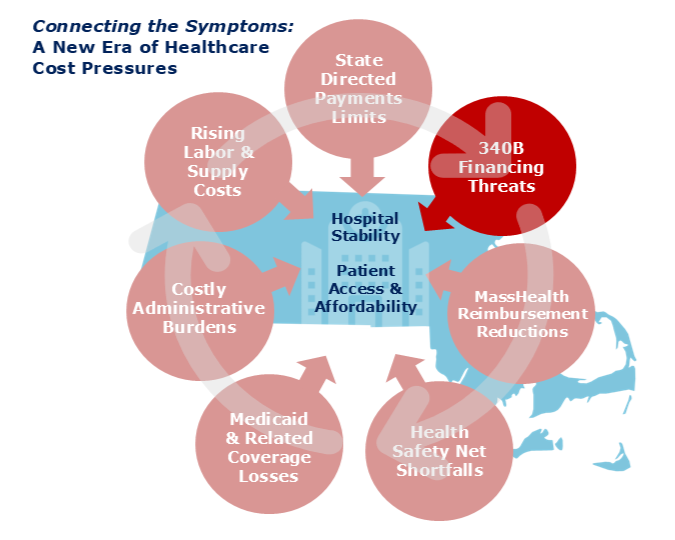
The federal 340B Drug Pricing Program has existed for 34 years and has become such an essential lifeline for the day-to-day operation of safety net hospitals and health systems that the recent attacks on it by pharmaceutical companies – as well as erosive policies from state and federal government – are of great concern to providers.
Under 340B, hospitals are allowed to buy outpatient medications directly from pharmaceutical companies at deep discounts (ranging from 20% to 50% off) and these savings have become embedded throughout hospital services and their communities. Given constraints with reimbursements from public and commercial insurers, 340B savings provide a necessary financing source for hospitals to support the growing expenses associated with serving patients. Hospitals rely upon these resources to sustain essential service lines, expand access to pharmacy services, support workforce investments, and finance numerous activities that benefit MassHealth members and other patients. Without 340B, these hospital programs would operate at a loss.
The 340B discounts are drawn solely from pharmaceutical profits and have become instrumental for safety net providers, especially as they operate on shrinking margins and brace for a new era of cost constraints in the near future. Hospitals have spoken first-hand about the services 340B allows them to deliver and the troubling consequences that would result from cutbacks to the program.
In Massachusetts, the state has been steadily chipping away at how 340B entities – hospitals, health systems, community health centers – can benefit from the federal program. In 2020, MassHealth carved out 25 high-cost drugs from MassHealth program, prohibiting coverage of these drugs if purchased using the 340B discount. Then in 2024, MassHealth instructed its managed care plans not to reimburse certain weight loss drugs prescribed to MassHealth members if the drugs were purchased through the 340B program. And this July, MassHealth fully carved-out all 340B drugs in its fee-for-service program despite significant opposition from MHA, community health centers, and other provider groups. MHA and the Mass. League of Community Health Centers recently urged legislative leaders to issue a one-year moratorium on the controversial carve-out policy.
Now, MassHealth is considering further changes that would affect hospital 340B financing. The state is currently considering changes to how pharmacy benefits are covered in its managed care programs, including a proposal that would carve-out 340B drugs for this population as well. Such a change would have devastating financial consequences for many safety net hospitals. To offset this financial loss, the state is considering pursuing a provision in its upcoming 1115 waiver renewal to establish a new funding program for hospitals in lieu of 340B financing for retail prescription drugs.
In its recent communications with the state, MHA has once again stressed that its membership is against any Medicaid 340B carve-out or any financing strategy that is conditioned on hospitals relinquishing their existing 340B benefits. Given the uncertainty of consistent state financing – dependent on legislative appropriations, economic fluctuations, and other ever-changing variables – such supplemental payments introduce more risk into the system. Such an approach would also merely substitute one financing mechanism for another while introducing uncertainty, MHA argues. And devoting substantial waiver authority towards the replacement of existing hospital financing would reduce the commonwealth’s ability to pursue other needed investments through the waiver that will be required to mitigate the immense financial losses related to upcoming federal Medicaid changes.
At the federal level, some in Congress and the administration are moving ahead on a 340B drug rebate plan that would replace immediate upfront discounts with an after-the-fact reimbursement process. Hospitals would pay full list prices upfront, wait for manufacturer approvals, and then spend significant resources managing complex data claims, tech systems, and payment denials to eventually get their statutory discounts. A previous iteration of the rebate plan from the Health Resources and Services Administration (HRSA) was struck down by a federal court in December 2025; HRSA returned with a revised rebate plan this month that still contains the main elements of concern from the provider community – namely, hospitals are being instructed to finance drug purchases upfront while relying on drug manufacturers to voluntarily return the statutorily-owed discount after the fact.
The Provider Perspective
340B is exactly the type of solution we need to be embracing – not eroding – at this time. 340B savings help hospitals and community health centers keep care services afloat and reach underserved neighborhoods across the commonwealth. These are not excess revenues that can comparably be replaced through an alternative Medicaid payment methodology. They are integral to hospitals’ ability to fulfill their mission and cannot be risked – much less at this critical turning point for the provider community.
The Medicaid RFA: Access & Administrative Challenges
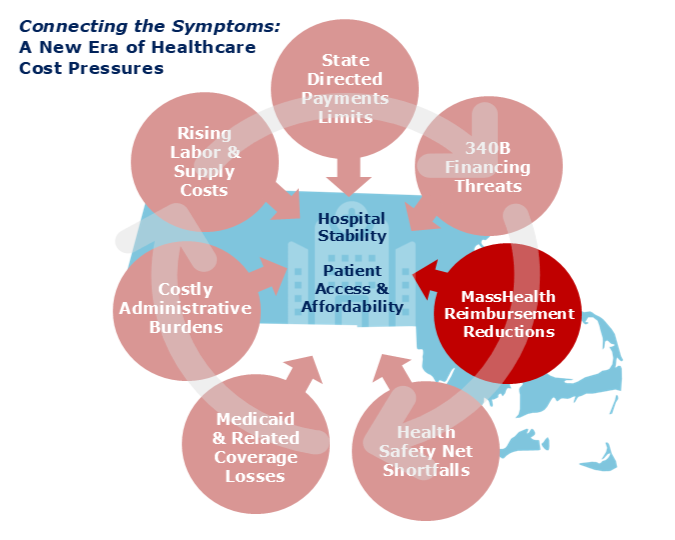
The MassHealth Acute Hospital Request for Applications (RFA) is the primary annual contractual agreement and policy framework between MassHealth and Massachusetts acute care hospitals, outlining Medicaid payment rates and operational standards for hospitals caring for MassHealth patients. The 2027 rate year RFA is expected to be released by the end of August, and will be effective October 1.
In response to MassHealth’s proposals that the state has previewed with hospitals over the past many months, MHA has warned that numerous changes in those proposals will challenge healthcare access and increase administrative burden, which will be especially problematic to hospitals and health systems given the other coverage losses and federal changes expected in the coming months and years.
Of great concern, the Executive Office of Health and Human Services (EOHHS) proposes eliminating hospital reimbursement for telehealth medical visits, while maintaining reimbursement for physician and community health center telehealth visits. Hospitals are currently reimbursed for telehealth services, which supports their expenses for the care delivery team providing the services to MassHealth patients, the ongoing costs of maintaining a virtual infrastructure, ensuring that providers have secure platforms that are HIPAA-compliant, and the costs for software licenses, IT support, and language interpreters. Additionally, this reimbursement supports the staff who schedule appointments and conduct follow-up care, including referrals and other EHR documentation. If the funding is cut, access to telehealth care for patients facing transportation issues, geographic barriers, or work scheduling issues will be disrupted, MHA has argued.
In the rate year 2027 RFA, EOHHS is anticipated to propose a post-payment utilization review for outpatient claims – introducing an added layer of administrative red tape for services that have already been provided, similar to practices used by many commercial payers that hospitals have challenged. EOHHS has assumed budgetary savings from the post-hospitalization reviews; MHA points out the very great possibility for a very large administrative burden that requires diverting clinical staff away from patients and towards documenting and appealing claims.
Another concern with the proposed RFA is the “72-Hour Rule” in which EOHHS proposes to bundle related outpatient services – including those provided in the emergency department (ED) or through observation status – into the inpatient payment if the care is provided within three calendar days. A concern is that resources provided during an ED visit will be unreimbursed despite appropriate efforts to treat, stabilize, and discharge the patient and record the encounter.
The Provider Perspective
The proposed set of RFA policies run counter to statewide goals to support primary care and healthcare access, and to reduce administrative burden. The very granular details of the RFA that we expect to be released shortly all coalesce into a very real wave of administrative burdens and reimbursement cuts that come at the worst possible time for hospitals and health systems. We remain hopeful that MassHealth will reconsider these proposals given our shared goals of promoting healthcare access and reducing administrative burden, especially given the severe Medicaid challenges in the years ahead.
The Health Safety Net: A Fraying Program
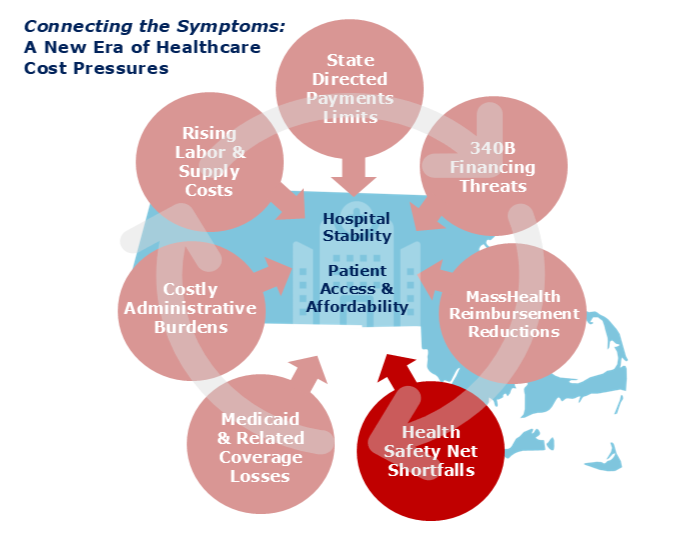
The Health Safety Net (HSN) pays hospitals and health centers for care provided to patients who are uninsured and underinsured. It is funded annually by a $165 million assessment on both hospitals and health insurers and $15 million in state funding. In nearly every year since its establishment in 2006, the Health Safety Net fund has run a deficit, meaning the cost of care to those it serves exceeds the money from the hospital-insurer-state assessment. By statute, hospitals alone bear the shortfall in funding. Those shortfalls, even with recent supplemental funding from the legislature and Healey-Driscoll administration, are now running at more than $200 million a year – representing one of the most pressing financial issues for hospitals today.
State policymakers have stepped up to deliver roughly $350 million in short-term relief to the fraying safety net over the past several years. But according to the Massachusetts Taxpayers Foundation, the Medicaid coverage changes alone in OB3 would more than double the number of uninsured individuals in the state and increase HSN demand by up to $510 million. This estimate aligns closely with the modeling estimates that MHA has collaborated on with EOHHS absent programmatic changes, with uninsured demand potentially higher due to further federal restrictions. Such an upward spike in HSN demand will place what MHA has termed “unsustainable” pressure on hospitals and health systems.
“In effect, hospitals alone are now financing the growing cost of care provided to low-income uninsured residents in local healthcare settings – an unsustainable equation with very real implications for patient access,” said MHA’s Senior Vice President of Healthcare Finance and Policy Dan McHale. “The long-term viability of the program depends upon establishing a sustainable financing strategy that recognizes both the anticipated growth in uncompensated care and the broader reductions in Medicaid financing that hospitals will experience over the next several years.” Those broader reductions in financing include the changes to State Directed Payments that will result in substantial reductions in Medicaid supplemental payments to hospitals.
Potential funding sources that could help rescue the current HSN, according to a proposal MHA has floated, include taking advantage of the savings the state itself will experience when Medicaid enrollment decreases due to OB3. Such funding reverting to the General Fund should “follow the patient” and be directed to the HSN, MHA has proposed. Another funding plan involves continuing what the governor and legislature opted to do this fiscal year – using interest from the Commonwealth Federal Matching and Debt Reduction Fund to help fund the safety net.
And importantly, MHA has posited, the shared responsibility for the HSN must be revisited. The insurer assessment that helps finance the Health Safety Net has remained effectively flat for nearly two decades, despite significant growth in healthcare costs and demand for services. At the same time, under the current HSN funding structure, community health centers receive priority access to HSN funding. As a result, when program funding falls short, as it consistently has in recent years, hospitals bear the financial burden. In acknowledgment of current and increasing pressures, EOHHS has engaged closely with hospitals and community health centers on potential reforms to ensure sustainability. One of the main mechanisms for supporting the state’s healthcare system as it prepares for the massive changes from OB3 and other federal policies is through the 1115 Medicaid waiver, which the state is currently drafting and will submit to CMS later this year.
The Provider Perspective
Change is long overdue to rebalance the share of financing the expenses of delivering care to the commonwealth’s low-income uninsured population. For too long, hospitals have been the primary financer of that care to the detriment of their daily operations, even with the state recently providing needed support through ad hoc legislative relief packages. MHA has also urged the state to not only identify new revenue sources, but also to ensure that any programmatic changes to the HSN rules do not place additional financial burdens on hospitals.
MHA believes new safety net resources must be identified as part of the commonwealth’s development of the Section 1115 waiver, which is a precious opportunity to soften the blow of future hospital losses. We look forward to advocating with the state on a financing strategy that reflects the magnitude of the financial challenges now facing the program. Absent new revenues, hospital support for the HSN program will become questionable and patient services will become even harder to maintain.