

 Massachusetts Health & Hospital Association
 1st in the Nation in Closing Disparities
INSIDE THE ISSUE
> Closing Care Disparities
> MassHealth Changes Coming
> Second Cohort Launched, Healthy Work Academy
> CHAPTER 58: 20 Years Later
> HWM State Budget Proposal Expected
> National Healthcare Decisions Day
> Transition – MassHealth’s Mike Levine
MONDAY REPORT
Mass. Hospitals’ Nation-Leading Steps to Close Care Disparities
Massachusetts is the first state in which every acute care hospital has achieved the Joint Commission’s Excellent Health Outcomes for All certification, an advanced program recognizing hospitals’ rigorous commitment to improving care access and closing longstanding disparities across patient populations.
This accomplishment is one part of Massachusetts hospitals’ broader, nation-leading effort to improve patient health outcomes through its Health Quality and Equity Incentive Program (HQEIP), a component of the state’s 1115 Medicaid Waiver from 2023 through 2027. The HQEIP is the first program of its kind in which acute care hospitals earn funding by meeting specific performance targets for reducing disparities in care, including standardizing data collection, expanding language access and disability competent care, and implementing performance improvement projects aimed at addressing gaps in behavioral and maternal health.
“Over these past three years, Massachusetts hospitals have taken significant steps to address health access and improve health outcomes for all patients across the commonwealth,” said MHA’s Director of Health Equity Walae Hayek. “The hospital community is proud that this important and extensive work is serving as a national exemplar, and we look forward to building upon this progress in the years ahead.”
“Our goal in Massachusetts is to create equitable health outcomes for people, regardless of their zip code, language, or ability to pay,” said Secretary of the Executive Office of Health and Human Services Kiame Mahaniah. “I applaud our hospitals’ efforts to collaborate and build more equitable health systems that will close the gap for communities experiencing higher rates of chronic illness and health complications. This work will have a long-lasting impact that will continue to benefit patients in Massachusetts for years to come.”
The Excellent Health Outcomes for All certification emphasizes key pillars that drive improvements in patient health outcomes: organizational leadership and commitment to closing disparities; collaboration with patients, families, and community partners; standardized data collection; provision of care focused on meeting patient needs; and continuous quality improvement. Over the past two years, the Joint Commission assessed all Massachusetts acute care hospitals and determined they met the comprehensive, required criteria across all five domains.
“The Excellent Health Outcomes for All certification affirms the progress we’ve made, but more importantly, it reinforces our commitment to continually improving the systems, practices, and partnerships that ensure every patient receives the highest standard of care,” said Carol Keohane, SVP, chief quality and safety officer, South Shore Health, the first system in Massachusetts to earn the certification.
“Achieving the Joint Commission’s Excellent Health Outcomes for All certification across all three Merrimack Health hospitals was a significant milestone for our system,” said Anthony Alley, R.N., chief nurse executive and quality officer, Merrimack Health. The system originally earned the certification for its Lawence General Hospital and then completed the process a second time upon taking over the former Holy Family Hospitals. “As a newly established health system, advancing quality, safety, and equitable care for every patient has been a top priority from day one and reflects a commitment by the organization at the highest levels.”
As a component of the commonwealth’s HQEIP, which requires a series of performance targets across its five-year timeline, the Joint Commission certification serves as one way that hospitals and health systems are embedding healthcare quality and equity into hospital operations. In the last three years, hospitals have: streamlined data collection of patient demographic information; trained more than 124,000 providers in disability competent care; increased screening for health-related social needs (HRSN) in their emergency departments; established community partnerships to connect patients to resources for HRSN; hired dedicated staff leaders to drive strategy and engagement; collaborated with Accountable Care Organization partners on interventions aimed at closing health disparities through improved clinical outcomes; and evaluated and improved the patient experience for patients needing accommodation and translation needs.
Now entering the HQEIP’s fourth year, Massachusetts hospitals have committed to achieving 204 health equity goals by 2027.
MassHealth to Members: Heads Up! Changes Are Coming
Big changes are coming to MassHealth as a result of the so-called One Big Beautiful Bill Act (OB3), which among other things imposes work requirements for members and more-frequent enrollment renewals. Those new administrative challenges, as well as eligibility changes, are expected to drive 175,00 currently enrolled individuals off MassHealth’s rolls by 2028, which will, in turn, place even greater pressures on the Health Safety Net. All totaled, including coverage losses in the Health Connector, more than 258,000 people in Massachusetts are estimated to lose health insurance coverage as a result of OB3.
Last week, MassHealth announced new resources for its members to help prepare for the changes. A member webpage outlines what members need to know about how the new federal law is changing MassHealth. As more details become available from the federal government by this summer, the webpage will be continually updated.
In October 2026, some immigrants legally in the U.S. will stop being eligible for MassHealth. In January 2027, MassHealth members who are 19 to 64 years old, and who do not have young children or a disability, will begin to be affected by new work or education requirements, and many members will need to renew their coverage every six months instead of each year. In October 2028, some members ages 19 to 64 may have to pay part of the cost for some healthcare services.
Currently, the Health Safety Net, which pays for the care provided to the uninsured and underinsured, is running a deficit that annualizes to $300 million without funding relief. Financing this deficiency is the sole responsibility of hospitals, adding to their already fraught financial standing. When the 258,000 are added to the uninsured population, the HSN deficit is estimated to balloon to approximately $800 million without additional funding or program changes, which would cause immeasurable harm to hospitals.
MHA, Hospitals Launch Second Cohort of Healthy Work Academy
Last week, Massachusetts hospitals launched the second cohort of the statewide Healthy Work Environment (HWE) Academy, which empowers nursing teams to lead sustainable improvements in workplace culture, nurse retention, and patient outcomes.
The HWE Academy is part of a broader initiative that the MHA Board of Trustees approved in early 2025 to further the commonwealth’s leadership in healthy and innovative work environments for nurses and care teams. Every hospital has committed to adopting one evidence-based program to support frontline professionals, with the Academy serving as one opportunity for participation.
Last year, the first cohort of 10 hospitals started their journey in the Clinical Scene Investigator Academy’s Nursing Workforce Solutions program – an initiative of the American Association of Critical-Care Nurses (AACN). The second cohort includes an additional nine hospitals, plus one repeat hospital from the first cohort that is enrolling another of its patient care units. Those hospitals are Beth Israel Deaconess Medical Center, Beverly Hospital, Cambridge Health Alliance, Cooley Dickinson Hospital, Emerson Health, Fairview Hospital, Lowell General Hospital, New England Baptist Hospital, UMass Memorial Health – Milford Regional Medical Center, and UMass Memorial Medical Center.

MHA is collaborating with AACN on the recruitment and implementation of both cohorts. The first cohort was made possible through funding support from Johnson & Johnson to AACN. Because that cohort was so successful, MHA opted to underwrite the costs of cohort two.
This second run of the HWE Academy is an intensive 12-month process in which each participating hospital identifies a nursing team unit to address a specific on-the-job challenge that is hindering their ability to work at their best. Through a series of in-person and virtual workshops, the teams will design, implement, and sustain projects to address that challenge. They will have access to educational sessions and expert mentoring throughout their journey and will be offered “train the trainer” resources to help scale their projects to other units in their organizations.
“This is a continuation of the nation-leading approach Massachusetts hospitals and health systems are taking to support their dedicated care professionals and spread their impact,” said Patricia Noga, PhD, R.N., vice president of clinical affairs at MHA. “MHA and our Board of Trustees are excited to support these nursing teams through this new cohort and make their ideas come to life at the bedside.”
The coordinated statewide initiative comes at a time of prolonged strain for the entire healthcare system, and as workers struggle with burnout, administrative burdens, and increasingly complex patient needs.
Some of the projects that this second cohort will work towards include:
- Creating a standardized post-event debrief and emotional support process for a set of clearly defined traumatic births and obstetric emergencies in a labor and delivery unit;
- Forming a transparent nursing workload-based assignment tool to ensure equitable patient assignments, and to strengthen trust, communication, and staff wellbeing; and
- Using data to create meaningful recognition programs, both from leadership and peers to improve nurse retention and satisfaction.
The statewide healthy work environment commitment is an initiative born out of MHA’s Workforce Leadership Task Force, which is composed of hospital and health system CEOs and chief nursing officers. The Task Force previously helped launch the Find Your Place in Healthcare campaign to draw people into the caring field, as well as a first-in-the-nation effort to reform the credentialing process with clinicians’ wellbeing in mind.
20 Years Later: Expanded Coverage Under Chapter 58
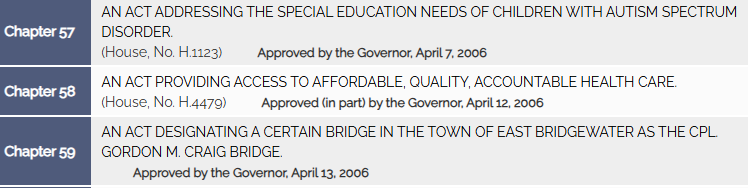
On Wednesday, April 12, 2006, at Faneuil Hall in Boston, then-Governor Mitt Romney signed into law Chapter 58, or what some would call “Romneycare” – the universal health coverage bill that would serve as the foundation for the Affordable Care Act (ACA), or “Obamacare” that would become the law of the land in 2010.
Chapter 58’s key components were an individual mandate, expansion of the Medicaid program and health insurance coverage subsidies for low income individuals not eligible for Medicaid, and establishment of the Connector Healthcare Exchange, a one-stop insurance plan shop for individuals and small businesses. It also called for multiple years of payments to hospitals and other providers designed to improve reimbursement for patients insured through Medicaid.
The question now, 20 years later, is: has Chapter 58 lived up to its promises? The most honest answer is: for the most part, yes.
Massachusetts has maintained a 98% insurance rate for its residents for well over a decade and consistently leads the country in this statistic. Access to care was significantly increased for hundreds of thousands of residents, including for primary care, which helped ease pressures on more expensive emergency departments. The ability to pay for insurance also became within reach for thousands through the innovative coverage options established through the Health Connector and Medicaid. These coverage expansions laid the foundation for future reforms, including efforts focused on population health management and alternative payment arrangements for healthcare providers. Without the expanded coverage achieved through Chapter 58 and later the ACA, Massachusetts and the nation would be facing even greater challenges in terms of health care access, patient outcomes, and healthcare financing.
The previous Uncompensated Care Pool that paid for uninsured care was consistently underfunded and placed enormous pressures on hospitals. The pool transitioned to the current “Health Safety Net” fund under Chapter 58 and it was assumed that as the insured rate rose, demand on the safety net would lessen. It did. Despite the success of Chapter 58 and ACA to expand coverage, a portion of the population remains uninsured, and the rising cost of care for them has meant – as has been consistently reported, even in this issue of Monday Report – that the Health Safety Net is as frayed as the pool once was. Annual funding for the safety net program is also largely the same as it was twenty years ago, contributing to funding shortfalls that now exceed levels predating Chapter 58.
Chapter 58 also included increased hospital and physician Medicaid funding meant to close the payment-to-cost gaps for providing care to an expanded MassHealth population. That funding was never fully realized due to budget constraints linked to economic downturns. Meanwhile, the cost of providing care since Chapter 58 has increased due to labor, pharmaceuticals, and other inputs that continues to result in Medicaid paying below the actual cost of care that hospitals provide.
Following Chapter 58, Massachusetts passed Chapter 305 in 2008 that created a payment reform commission; Chapter 288’s premium relief bill; the sweeping Chapter 224 in 2012 that created the cost growth benchmark and the regulatory agencies to monitor healthcare finances. Additional healthcare reform bills have followed, each chipping away at a portion of the problem.
On April 12, Governor Romney conceded that Chapter 58 was not a panacea but rather a vehicle to reach what “can” happen, not what “will” happen. And that “can” included, as he said, “every citizen with affordable, comprehensive health insurance; small businesses able to conveniently buy insurance for their employees at a cost that’s competitive with big businesses; medical transparency, bringing marketplace dynamics to healthcare, really for the first time; and finally beginning to rein in health inflation.”
But more work is needed to address Medicaid payment adequacy, strengthen the safety net, lower premium growth, and improve healthcare affordability. Perhaps what Chapter 58 and the reform bills that followed did impress on the Massachusetts experience was to position the commonwealth as a smart, policy-driven state not only unafraid to tackle the healthcare conundrum but also unwilling to stop trying.
As one participant, Sen. Edward Kennedy, said at Faneuil Hall 20 years ago, “Looking back from the future, may it be said that of this day, that something good and lasting happened here.”
House Ways & Means Budget Expected This Week
The Massachusetts House Ways & Means Committee is expected to release its Fiscal Year 2027 state budget proposal this week. The House usually sets a quick deadline for any amendments to the document with debate on the proposal expected to start the week of April 27.
Governor Healey released the administration’s budget proposal at the end of January. That $62.8 billion document increased MassHealth spending by a modest 2.5% and cut MassHealth coverage for GLP-1 drugs. MHA will be reviewing the House proposal and will file amendments to it if needed. The basic ask, however, from the hospital community given the compounding federal funding cuts that will occur over the next two years is that hospitals not be asked to shoulder any further financial or administrative burdens as they partner with the state in navigating through One Big Beautiful Bill Act ramifications.
New, unanticipated costs to the Health Safety Net are already occurring due to OB3, including the January 1, 2026, loss of ConnectorCare insurance for 36,000 individuals earning below the poverty level. MHA has prioritized financial stability of the Health Safety Net in the budget to ensure healthcare providers have the resources to support the care they deliver to patients regardless of their insurance status.
National Healthcare Decisions Day is April 16; Take a Simple Step!
This Thursday, April 16, is National Healthcare Decisions Day when the public is encouraged to give serious thought to advance care planning. A main step in this process, and one all adults over age 18 should take, is to designate a healthcare agent to make healthcare decisions for you if you are unable to make decisions yourself. Individuals can fill out a two-page health proxy document to designate an agent and outline their responsibilities.
MHA, Honoring Choices Massachusetts, and a coalition of leading healthcare advocacy groups continue to support the Simple Step Campaign to urge patients to designate a healthcare agent and complete a healthcare proxy.
On Thursday, from noon to 1 p.m., MHA is holding a webinar in its Engaging with Aging Series entitled “Take a Simple Step: Become a Healthcare Planning Ambassador” featuring Honoring Choices CEO Ellen DiPaola. Register for the free webinar here.
Transition – Levine to Leave MassHealth
Mike Levine, the Health & Human Services Undersecretary for MassHealth, is leaving the post to lead San Francisco’s Department of Homelessness and Supportive Housing, San Francisco Mayor Daniel Lurie announced last week.
During Levine’s career with MassHealth, but especially during the three years of his leadership, the state’s Medicaid program made remarkable – some have termed them historic – strides to ensure healthcare in the state is delivered in a more equitable and cost effective manner. His collaborative work with hospital and patient advocate interests, along with the breadth of healthcare stakeholders, from insurers to community health clinics and more, has always generated admiration and respect.
Levine’s work with Massachusetts hospitals and health systems spans numerous initiatives, including the innovative MassHealth Accountable Care Organization (ACO) program, supporting providers with substantial relief during the COVID-19 public health emergency, and helping to craft the current 1115 waiver. One of his signature efforts was the notable collaboration between the hospital community and MassHealth to dramatically improve hospital financing in the Medicaid program, including funding that now supports health equity, improved clinical quality outcomes, safety net providers, delivery system reforms, and hospital services provided to MassHealth patients.
“Secretary Levine has helped us usher in new ways of care delivery that showed the rest of the nation how to walk the walk when it comes to patient access,” said MHA President & CEO Steve Walsh. “His creative collaboration with hospitals on the Medicaid waiver, innovative delivery models, and financing arrangements has provided our state with new avenues for care and important resources from federal partners. He’s a remarkable public servant whose work has resulted in very definable, meaningful benefits for the state’s healthcare system, and especially for those patients most in need of support. We know he will bring that same compassion and collaborative approach to the people of San Francisco – especially those experiencing homelessness.”