

 Massachusetts Health & Hospital Association
 Concern Over Transplants; State of the State
INSIDE THE ISSUE
> Transplant Lawsuit
> The State of the State
> Trahan on “Essential Hospitals”
> Healthcare Extenders Bill
> TPS for Haitians
MONDAY REPORT
Lawsuit Details How CMS Transplant Rule Will Destabilize System
New federal rules regarding how organ procurement organizations (OPOs) across the United States are recertified may lead to more than a third of current OPOs being shut down and many of the remaining ones vying against each other in a “cutthroat, iterative Hunger-Games-style competition,” according to a lawsuit brought by New England Donor Services (NEDS) and two other groups.
There are 55 OPOs in the U.S., each exclusively serving distinct “donation service area” (DSA). They arrange for the acquisition, preservation, and transportation of donated organs, working with donor families, hospitals, transport companies, physicians, and the national entity overseeing organ matching and allocation. OPOs can’t cross over into another DSA to receive organs, and hospitals within a DSA can only work with that DSA’s OPO – or else they forfeit their participation in Medicare. Purchasing organs is illegal. The complex, regional, non-competitive OPO process ensures fairness in the transplant process.
But now in 2026, CMS will enforce its new rules that its critics say will upend the system. CMS is evaluating OPOs based on two measures: the rate of organ donations from donors in the OPOs’ service area and the rate of transplantations of organs from donors in their DSA. It will use old 2024 data to determine which OPOs are in Tier 1, meaning they will be recertified for the next four years; Tier 3, meaning they will be decertified; or Tier 2, meaning the OPO will be eligible for re-certification but will have to compete against Tier 1 and other Tier 2 OPOs to retain their donation service area.
CMS estimates that 22 OPOs – or 40% of the nation’s total – could be placed in Tier 3 and eliminated. “Future cycles of this rank-and-yank policy will reduce the field further, until the whole system is reduced to less than a handful of national OPOs,” New England Donor Services (NEDS), Gift of Life Michigan, and We Are Sharing Home, South Carolina wrote in the lawsuit against U.S. Health & Human Services and the Centers for Medicare and Medicaid Services (CMS).
NEDS experienced a record-breaking year for organ donations and transplants in 2025. Last year, the organization – whose DSA is Connecticut, Maine, Massachusetts, New Hampshire, Rhode Island, some eastern counties of Vermont, and Bermuda – coordinated organ donations from 640 deceased donors resulting in 1,692 transplants. Last year’s record of organ transplants represents the fifth year of consecutive growth in transplants and places NEDS among the nation’s top three OPOs by donor and transplant volume. Yet, according to the CMS metrics, NEDS is in Tier 2 and will therefore have to compete with other parts of the country in order to survive. The current certification cycle ends on July 31, with the new evaluations beginning on August 1, 2026.
“Congress directed CMS to measure OPOs’ performance within their defined service area,” according to the lawsuit brought in the U.S. District Court for D.C. “Nothing in the statute authorizes CMS to ignore the specific challenges endemic to each service area and to rank OPOs against each other—or to base re-certification on ever-shifting and unknown comparisons to other OPOs serving different areas with different populations, death rates, donor hospitals, transplant centers, and resource constraints. Nor does the statute provide any authority for CMS to force OPOs to compete against each other to take over a designated service area. To the contrary, Congress deliberately designed the system to eliminate and prevent competition—because it recognized that a competitive and commercial market for organ donation would lead to unsafe conditions, abuse and exploitation, and would be damaging to public health.”
While OPOs believe that their groups should be regulated and assessed to ensure they are best serving their service areas, there is widespread criticism of the metrics CMS has chosen to carry out those assessments. Many factors outside the OPOs’ control – population density in a service area, the demographics and health of the population, and the availability of transplant hospitals – affect the donation and transplantation rates in a DSA. As the lawsuit notes, “In particular, the transplantation rate is highly dependent on factors outside an OPO’s control given that OPOs do not decide whether or not to transplant an organ. As a result, objectively successful OPOs that operate in under-resourced or disadvantaged areas will be penalized and threatened with decertification – even if their organizational performance is above the national average and their ranking is based on factors wholly outside their control.”
Governor Discusses Affordability Agenda in State of the State
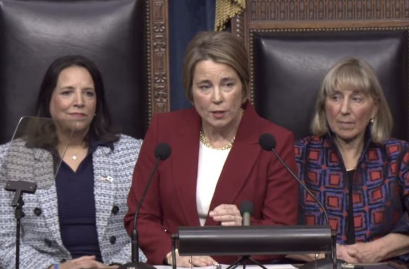
Governor Maura Healey delivered a mostly upbeat State of the State speech last Thursday, stressing her “affordability agenda” in relation to housing, energy, and healthcare.
“We have the best care and most coverage in America,” Healey said before an audience that included former Governors Bill Weld and Michael Dukakis. “But premiums are up everywhere. It’s hard to afford, and it’s hard to get appointments too. So we’re taking action.”
She discussed her recent use of $250 million from the Commonwealth Care Trust Fund (CCTF) to assist some Massachusetts residents who have lost enhanced premium tax credits. And she touted her decision on January 14 to eliminate prior authorization requirements for many services, including emergency and urgent care, primary care, chronic care, occupational and physical therapy, substance use disorder treatment, post-acute care services provided on weekends and holidays, and certain prescription drugs.
“How many of you have had this experience? Your doctor prescribes medicine or orders a procedure. Instead of getting that treatment, you wait. You wait for an insurance company to sign off. You lose weeks or months. You make new appointments. Take more time off work. It costs you money and delays your care,” the governor said. “… So we’re changing that. Starting this year, you won’t need prior authorization from any insurance company to get the care you need. No more paperwork, no more waiting. If your doctor says you need it, you’ll get it.”
Additionally, the governor announced that her administration will advance regulations that will prohibit medical debt from being reported to credit agencies, saying, “It’s bad enough to get a huge bill when you’re dealing with an illness. It shouldn’t wreck your credit too.” A recent brief from the Center for Health Information and Analysis found that 12.7% of Massachusetts residents carry medical debt – particularly those with high deductible health plans and from lower-income households.
Healey also mentioned the new Health Care Affordability Working Group that she created to bring together leaders in the sector, including MHA, to hammer out a cost-reduction plan. “We’re the state with the best healthcare, we’re going to be the state to figure it out and fix it for our people,” she said to applause.
Trahan Bill Supports “Essential Health Systems”
U.S. Rep. Lori Trahan (D-Mass.) has joined with Rep. David Valadao (R-Calif.) to re-introduce the Reinforcing Essential Health Systems for Communities Act, which would define “essential health systems” in federal law and thereby open new funding paths for them.
Hospitals would qualify as “essential health systems” by meeting one of the following criteria for at least two out the past three years:
- The hospital’s patients are at least 35% low-income, based on Medicaid use and low-income Medicare patients;
- The hospital provides at least 0.05% of all unpaid hospital care in the entire country, making it one of the hospitals delivering the most uncompensated care nationwide; and
- The hospital is in the top 16% of providers in its state that serve low-income and/or unpaid care.
“By reintroducing the Reinforcing Essential Health Systems for Communities Act, we’re reaffirming our commitment to ensuring these hospitals are better positioned to receive the resources they need to keep their doors open and their communities healthy,” Trahan said. “This bill gives Congress a smarter, fairer way to direct support to the health systems that serve as lifelines in cities and towns across the country.”
Trahan said 17 hospitals in Massachusetts would meet the essential health system definition. “Safety net hospitals operate on razor-thin margins while serving our most vulnerable neighbors, including patients that are low-income and uninsured, and sustaining critical community programs,” said Amy Hoey, RN, the president of one of those 17 – Tufts Medicine’s Lowell General Hospital. “This designation rightly acknowledges their indispensable role in public health.”
House and Senate Release FY 2026 HHS Funding Bill, Including Extenders
With just days before federal funding expires on January 30, House and Senate appropriators released a multi-bill minibus funding package last week covering the Defense, Homeland Security, Labor, Health and Human Services (HHS), Education, Transportation, and Housing and Urban Development agencies. The bipartisan bill, which passed the House on Friday with a vote of 341-88, would provide $116.6 billion in discretionary funding to HHS, an increase from current funding levels while notably including extensions for a package of expiring health provisions.
Those expiring health extenders include:
- A two-year extension of Medicare telehealth flexibilities;
- A five-year extension of the authorization for acute hospital-at-home programs;
- A one-year extension of the Medicare-dependent hospital and low-volume adjustment programs; and
- A one-year delay of payment reductions for clinical laboratory services.
The bill also includes a two-year elimination of cuts to Medicaid disproportionate share hospitals (DSH). When the Affordable Care Act passed, Congress included $24 billion in cuts over three years to the DSH under the reasoning that as more people became insured, funding to the DSH, which serve many uninsured and underinsured patients, could be reduced. But it became apparent that cuts of that magnitude would severely harm the hospitals and the cuts have been consistently delayed or extended. This bill is notable in that eliminates the cuts for two of the three years.
The bill also includes a number of long-time bipartisan healthcare policies, including reforms of pharmacy benefit managers and a directive to state Medicaid programs to streamline out-of-state provider enrollment for treating rare pediatric diseases. The bill would also require separate unique health identifiers, and a national provider identifier number for off-campus hospital outpatient departments, which the American Hospital Association has stated is unnecessary and would increase hospital administrative burden.
The funding portion of the bill provides $823,776,000 for Title VII and VIII workforce training programs, which is an $8 million increase from current funding levels, as well as investments in substance use disorder and behavioral health programs.
The package does not include an extension of the expired enhanced premium tax credits for Affordable Care Act marketplace plans. After passing the House, the bill now heads to the Senate and is expected to be taken up this week before the January 30 deadline.
The full bill text and summaries can be found here.
Loss of TPS for Haitians is a Blow to U.S. Healthcare
Effective at 11:59 p.m. on Tuesday, February 3, Temporary Protected Status (TPS) for Haiti will end, meaning that approximately 353,000 Haitians who entered the United States under the program, including approximately 45,000 in Massachusetts, face deportation.
The TPS decision on Haiti from the Department of Homeland Security is one of many TPS cancellations that have occurred in the past year under the Trump administration. TPS grants temporary legal status, work authorization, and deportation protection to foreign nationals from designated countries facing conflict, natural disasters, or extraordinary conditions making their return unsafe.
In issuing the order, Secretary of Homeland Security Kristi Noem noted that conditions in Haiti are still “concerning.” The U.S. Ambassador to the United Nations Michael Waltz said of Haiti in October 2025, “We have gangs that are terrorizing communities, extorting families, recruiting children to commit horrors on behalf of the gang leaders. The spillover effects of this violence threaten not only Haiti but the stability of the wider Caribbean and the Western Hemisphere.” In her order, Noem declared that nonetheless the U.S. “must prioritize its national interests” by ending the TPS.
The Haiti decision is especially troubling for the healthcare sector, which employs more than 133,400 Haitian workers nationwide, according to the Center for Economic and Policy Research. Massachusetts is home to about 99,000 people of Haitian descent, of which an estimated 45,000 are here under TPS. Many of those are employed within the state’s post-acute care sector.
“Extending TPS for Haiti isn’t just the moral, humanitarian thing to do—it is also good policy, ensuring that our TPS holders, many of whom work in healthcare and elder care sectors, can continue their essential work and contributions to our communities,” said U.S. Rep. Ayanna Pressley (D-Mass.), who is attempting to gather support in the House to extend Haiti TPS for three years.