

 Massachusetts Health & Hospital Association
INSIDE THE ISSUE
> Klibanski Elected MHA Chair
> Healey Addresses Annual Meeting
> “Frontline of the Economy”
> Awards for Schepici and Pollack
> HR Workers Lauded
> State Budget Proposal
> Limiting ICE
MONDAY REPORT
Anne Klibanski, M.D., Elected Chair of MHA’s Board of Trustees
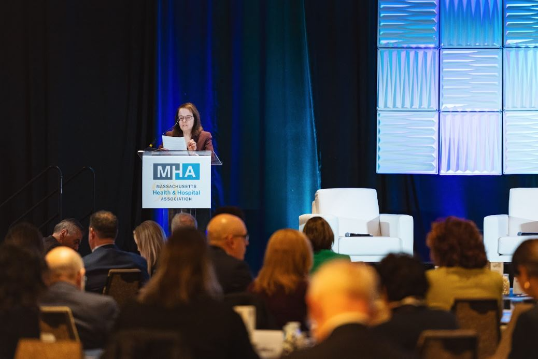
Anne Klibanski, M.D., the president & CEO of Mass General Brigham, was elected as chair of the Massachusetts Health & Hospital Association’s (MHA’s) Board of Trustees at MHA’s Annual Meeting last Thursday that drew 600 attendees and celebrated the 90th anniversary of the organization. Klibanski, who oversees the largest employer in the commonwealth, succeeds Michael Lauf, president and CEO of Cape Cod Healthcare, as MHA’s board chair.
In her comments to the board and later to the entire annual meeting, Klibanski stressed the importance of united problem solving as 2026 gets underway. She said, “We have to evolve beyond a status quo that is not working” and urged the hospital community to come together with “collective advocacy” to bring about the changes that are needed to make the healthcare system more affordable and efficient while maintaining high-quality care.
“Healthcare is undergoing profound change, and meeting this moment requires partnership, clarity of purpose, and a commitment to the patients and communities we serve,” she said. “The integration of our system, bringing together exceptional clinicians and teams across MGB’s hospitals, demonstrates what aligned, patient-centered care can achieve. Together with MHA and our colleagues statewide, we will advance research, innovation, and high-quality care for all Massachusetts residents.”
Klibanski received her B.A., magna cum laude in literature from Barnard College and her M.D. from New York University Medical Center. She is the Laurie Carrol Guthart Professor of Medicine at Harvard Medical School. She has been MGB’s chief executive since 2019.
“Dr. Klibanski’s leadership exemplifies the profound promise of healthcare for today’s world – from lifesaving research breakthroughs to care that extends far beyond hospital walls,” said MHA President and CEO Steve Walsh. “We are honored that she will serve as MHA’s 2026 board chair as our members take on an ambitious agenda to build a more innovative, resilient system for patients and healthcare workers.”
In addition to Klibanski’s election as board chair, MHA welcomed new board members Edward Moore, president of UMass Memorial Health – Harrington Hospital; Diana Richardson, president and CEO of Merrimack Health; and Elsie Taveras, M.D., chief community health and health equity officer at Mass General Brigham.
The Board of Trustees’ Executive Committee now consists of Klibanski; Lauf; Walsh; Michael Dandorph, the president & CEO of Tufts Medicine; Aimee Brewer, president & CEO of Sturdy Health; Spiros Hatiras, president & CEO, Holyoke Medical Center & Valley Health Systems; and Kevin Tabb, M.D., president & CEO, Beth Israel Lahey Health.
Healey: “The Moment Right Now Calls for Action”

Maura Healey, for the fourth time since being elected governor of Massachusetts in 2023, addressed MHA’s Annual Meeting, telling the crowd of more than 600 attendees, “The moment right now calls for action.”
Healey’s speech was both an upbeat oration that discussed the achievement of the Massachusetts healthcare system, but also a cautionary tale of how the system is at risk without corrective action.
“Making sure we shore up investments in what has been an important sector in the state is important,” the governor said, adding that she hoped attendees would lend support to her “DRIVE Act” that she introduced last summer. DRIVE stands for “Discovery, Research and Innovation for a Vibrant Economy,” consisting of a $200 million research funding pool housed at MassDevelopment, and another $200 million for public higher education campuses to support direct and indirect costs of research.
Healey noted that healthcare is an integral part of her affordability agenda, which is focused on lowering the cost of housing by rapidly creating more housing stock, improving transportation options, and attempting to drive down the cost of energy. The governor discussed her recent actions to provide premium relief for 270,000 residents through the release of state funds, and the state-mandated elimination of insurer prior authorizations for a number of services. She also created a new affordability task force that she instructed to deliver concrete cost-reduction strategies by the summer.
“Healthcare in America is broken and Massachusetts is not immune,” Healey cautioned. Referencing the MHA healthcare economic report that was released at the annual meeting (see story below), the governor said the data clearly shows that the healthcare sector is a fundamental part of the commonwealth’s success.
“I saw the latest report,” she said. “I just want you to know that I know those numbers, I appreciate you, and I appreciate your teams.”
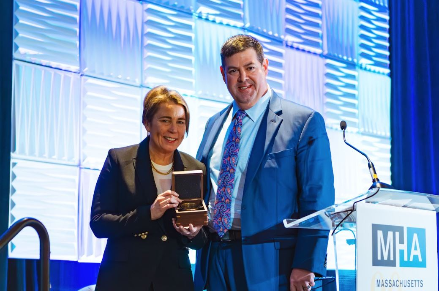
Following her speech, MHA President & CEO Steve Walsh presented Governor Healey with MHA’s Health and Hospital Hero Award, noting that Healey has stepped up many times for healthcare, dating back to her time as Attorney General, including supporting the Health Safety Net and helping to save hospitals that Steward Health Care previously owned.
New Report Shows Importance of Healthcare Ecosystem
A new MHA report, “Frontline of the Economy, The Ripple Effects of Massachusetts Healthcare,” details the economic and community power of the healthcare ecosystem in Massachusetts, which generates $94 billion in annual economic activity and supports more than 452,000 jobs across sectors statewide. The report also highlights broader trends shaping the sector, including workforce growth, innovative care, and hospitals’ role in strengthening local communities and public health.
“Each day, Massachusetts’ #1-ranked healthcare system brings children into the world, cures debilitating diseases, and saves lives,” the report notes. “Its workers are uplifted by the nature of their mission, and hospitals uplift communities by providing rewarding careers, fueling local investments, and serving as the most reliable resource for anyone in need – 24/7/365.”
Hospitals are among the largest employers in the state, and they help fuel the innovation economy that defines the commonwealth. Hospitals and health systems also devote more than $4 billion annually to provide subsidized care for low-income patients and to fund programs within their communities that improve health outcomes. All that is in addition to the globally recognized care that they provide.
“Healthcare is not just central to the wellbeing of Massachusetts residents, it is one of the most important drivers of our economy,” Massachusetts Executive Office of Economic Development Secretary Eric Paley says in the report. “Hospitals and health systems support hundreds of thousands of jobs, generate billions in economic activity, and anchor local economies in every region of the state. Their stability and success ripple outward, sustaining families, supporting our state’s unmatched quality of life, fueling innovation, and reinforcing Massachusetts’ long-term competitiveness.”
Awards for Two Healthcare Leaders
MHA’s Annual Meeting allows the association to present two of its prestigious recognitions – The William L. Lane Hospital Advocate Award and The Stephen Hegarty Memorial Award.
The Lane Award, established in 2004, embodies the spirit of William Lane, who served as a hospital CEO for more than 30 years and was among the most ardent advocates for hospitals in the commonwealth’s history. The award recognizes professional excellence, outstanding achievements, innovative accomplishments, extraordinary compassion in caring for patients, success in overcoming barriers, and exemplary advocacy on behalf of provider organizations, patients, and the healthcare system as a whole.
This year the award was presented to Denise Schepici, who recently retired as president of Martha’s Vineyard Hospital and Windemere Nursing & Rehabilitation Center after eight years and after devoting almost three decades of service to Massachusetts healthcare.
In presenting the award to Schepici, Mass Eye & Ear President CarolAnn Williams said, “She helped address two of Martha’s Vineyard’s most pressing needs – affordable staff housing and long-term care for seniors. With support from her partners, Denise helped develop the Edgartown workforce housing project and Navigator Homes of Martha’s Vineyard, a new skilled nursing facility. These have been spotlighted as national models, and they are a shining example of what our sector makes possible. And Denise did it all while overseeing unprecedented growth for the hospital itself, adding 40 new clinical services that reduce the need for off-island travel.”
The Stephen Hegarty Memorial Award, named after former MHA President Hegarty, recognizes an individual whose leadership has significantly advanced patient care. This year, MHA presented the award to Rick Pollack, the president and CEO of the American Hospital Association (AHA), who announced this year he was retiring after a 43-year career at AHA. Pollack led the association through the COVID-19 pandemic, strengthened the healthcare workforce, advanced quality and patient safety, and built a national advocacy network that has expanded access and improved coverage for millions of Americans. In a fireside chat with MHA’s Steve Walsh, Pollack recounted specific patient experiences, beyond just policy victories, that helped define his career.
HR Leaders: “The People Behind the People”
The medical system puts patients first but it’s the workers delivering that care that makes the Massachusetts healthcare system so well respected. And the human resources professionals that are involved in the workforce experience, from hiring to participating in wellness teams to resolving tough day-to-day issues, ensure that hospitals and health systems run efficiently.
MHA’s Annual Meeting took time last Thursday to recognize the role of the HR professional. Christine Schuster, R.N., the president & CEO of Emerson Health, said of HR personnel, “Simply put, these are the people behind the people. Behind every dedicated caregiver is an HR team that ensures their own needs are being met. Behind every innovative idea is someone who ensures we have the right talent and expertise to implement it on-the-ground. And behind every patient success story is a network of leaders who hired, invested in, supported, and developed the right people to make it possible.”
In recognition of their efforts, MHA is presenting HR leaders with compasses that note the profession “makes pathways for people and purpose.”
Governor Releases FY2027 Budget Proposal
Last Wednesday, Governor Maura Healey filed her administration’s FY2027 budget proposal, otherwise known as H.2. The $62.8 billion budget remains balanced, addresses federal threats, and prioritizes investments in people and institutions while not raising taxes or fees.
The budget reflects significant pressure from rising MassHealth and state workforce costs, which have been worsened by recent federal actions and a lack of financial relief. For FY2027, the administration expects to bring in $44.9 billion in revenue, a 2.9% increase that includes Fair Share surtax revenue. The budget ultimately keeps spending increases small, holding growth to 1.1% above projected FY2026 spending and 3.5% above the final FY2026 budget.
In H.2, the MassHealth program spending grows to $22.701 billion – a 2.5% increase compared to the FY2026 budget. This is a significantly lower increase compared to previous years, including the FY2026 budget’s 10% increase. For all providers, rates will remain flat. Of significant concern to health systems that support MassHealth Accountable Care Organizations (ACOs), the Executive Office of Health and Human Services will implement a 50% reduction in funding for care coordination, reducing funding support for these services by approximately $80 million. Related, EOHHS will end the requirement that MassHealth ACOs contract with Community Partners, which currently collaborates with ACOs in care coordination efforts. It’s anticipated that both ACOs and Community Partners will therefore experience the $80 million in payment reductions.
Like many commercial payers and other Medicaid programs, MassHealth will no longer cover GLP-1 drugs for weight loss. MassHealth will also introduce an annual $1,000 cap per enrollee for adult dental coverage, which is anticipated to save $60 million in net state costs. Additional savings are assumed in the budget for initiatives to be developed through stakeholder processes related to Personal Care Attendants services, Adult Day Health, and Adult Foster Care.
The governor’s budget calls for the customary $15 million funding transfer to support the Health Safety Net program in FY2027. Separate from the annual transfer, an additional $100 million in funding is anticipated related to provisions included in the FY2025 closeout supplemental budget. Even with the infusion of the relief funding, the Health Safety Net is projected to once again experience significant funding shortfalls in FY2027 due to the effect of the One Big, Beautiful Bill Act, among other factors. Effective earlier this month, one provision from the federal law eliminated ConnectorCare coverage for 36,000 individuals with incomes below the poverty level. MHA estimates that this coverage loss alone will increase Health Safety Net demand by $105 million in FY2027.
MHA is continuing to analyze the many aspects of the budget proposal, especially in light of the increased pressures on the healthcare system that will result from implementation of coverage and payment elements of the federal One Big Beautiful Bill Act. The House is expected to release its own FY2027 budget proposal in April.
Healey Files Bill, Signs Order Cracking Down on ICE
Governor Healey, shortly after leaving MHA’s Annual Meeting, announced that she would file legislation to limit the ability of U.S. Immigration and Customs Enforcement (ICE) to conduct enforcement actions in “protected areas,” including hospitals, courthouses, schools, childcare programs, and churches.
Her legislation would also make it unlawful for another state to deploy its National Guard in Massachusetts without the governor’s permission, and would allow parents to pre-arrange guardianship for their children in case they are detained or deported. The legislation was filed as part of a 2026 supplemental budget.
According to a media release from the governor’s office, her legislation “would prohibit hospitals, community health centers, nursing homes, and substance use disorder programs from granting ICE access to non-public areas without a judicial warrant. These facilities will also be required to issue policies on how their staff and volunteers should interact with or respond to requests from ICE. In Massachusetts, no one should have to hesitate to seek essential or life-saving medical treatment because they fear detention, deportation or being separated from their families.”
MHA said of her directive, “Our hospitals take pride in creating a safe and welcoming environment for every person in need. That fundamental responsibility has not and will not change, and we appreciate the Healey-Driscoll administration’s strong commitment to protecting patients seeking services. Massachusetts hospitals will continue to prioritize our core mission: delivering compassionate, high-quality care to all.”
Healey also signed an executive order prohibiting any office or agency in the Executive Department from signing so-called 287(g) orders, which essentially allow state and local agencies to act as immigration enforcement agents. Her order also prohibits civil arrests by federal immigration officers in non-public areas of state facilities, except when authorized by a judicial warrant or judicial order; prohibits certain state facilities from being used as staging areas or for processing by ICE.
Massachusetts Attorney General Andrea Joy Campbell lauded the governor’s actions, saying. “ICE’s activity across the country is a reckless, dangerous and lawless abuse of power. When militarized federal agents kill people in the streets, detain innocent children, attack protesters with tear gas and pepper spray, and remove law-abiding residents from their loved ones, it does nothing to make our communities safer.”