

 Massachusetts Health & Hospital Association
 Where’s the Coverage for Innovative Care Delivery?
INSIDE THE ISSUE
> Legislating Fair Payment for Care
> 340B
> Norwood Hospital
> Medical Respite Pilot Program
> Primary Care Practice Ratings
> Transition: Tabb at BILH
MONDAY REPORT
Innovative Care Models Work. Now They Need Funding.
If the strategy is to keep patients out of hospitals to allow them to stay closer to their homes and loved ones, while reducing overall healthcare costs and addressing the hospital bed “capacity crisis,” then the concepts of “hospital at home (HAH)” and “mobile integrated health (MIH)” make perfect sense.
This Wednesday at 11 a.m. in the House Members’ Lounge at the State House there will be a briefing on HAH and MIH, hosted by the House Chair of the Joint Committee on Health Care Financing John Lawn (D-Watertown), House Chair of the Joint Committee on Cannabis Policy Rep. Dan Donahue (D-Worcester), and House Chair of the Joint Committee on Bonding, Capital Expenditures and State Assets Mike Finn (D-West Springfield). They will be joined by representatives from MHA, UMass Memorial Health, and Mass General Brigham, among others.
Hospital at Home programs allow patients to receive acute-level inpatient care in the comfort of their own home. This can include services like daily in-person and virtual visits, remote vital sign monitoring, IV therapy, and other hospital-level interventions. Mobile Integrated Health allows providers to leverage mobile resources, including EMS, to deliver ongoing care to patients in a personalized environment outside of healthcare facilities. EMS professionals visit the patient’s residence, facilitate treatment, and connect patients virtually with their clinicians – in many cases diverting patients to alternative care sites so that they do not need to be transported to hospital emergency departments.
HAH is not a new concept by any means. Hospitals have been experimenting with remote care models for years but the Hospital at Home model was made formal in 2020 when the federal government created the Acute Hospital Care at Home program in response to the COVID-19 pandemic. MIH programs have been in existence in various forms since the 1990s, with Massachusetts creating a Mobile Integrated Health Advisory Council in 2015. There have been numerous studies and extensive research on the HAH and MIH care delivery models, usually showing that the programs benefit patients, ease the strain on hospitals, and save money by keeping people out of more expensive emergency settings.
Another common finding over the years is that HAH and MIH have been historically underfunded, especially among commercial health insurers. Many programs currently operate on grants, donations, or at a significant loss – meaning they are unsustainable in the long-run.
Currently at the State House there are two bills aimed at helping HAH and MIH thrive. H.1141/S.806, An Act Increasing Access to Acute Hospital at Home Services, sponsored by Rep. Daniel Donahue (D-Worcester) and Sen. Patrick O’Connor (R-Weymouth) would require commercial insurance companies to cover and reimburse for Hospital at Home programs delivered by local providers. While Medicare and MassHealth currently cover and reimburse for Hospital at Home Programs, there is currently no requirement for commercial insurance plans licensed in Massachusetts to do so.
H.1154/S.726, An Act Relative to Insurance Coverage of Mobile Integrated Health, sponsored by Rep. Michael Finn (D-West Springfield) and Sen. Bill Driscoll (D-Milton) would prohibit public and private health plans from refusing to cover healthcare services on the basis that they were delivered by a state-approved Mobile Integrated Health program, and would require that MIH services be covered to the same extent as they would have had they been provided in a healthcare facility.
“Legislative action is needed to empower these community-based delivery models to expand and reach all eligible commonwealth patients,” said MHA’s Vice President, Government Advocacy & Public Policy Emily Dulong. “Without consistent coverage and reimbursement across Massachusetts payers, we risk falling behind other states and missing an essential opportunity to modernize care delivery, improve the patient experience, and avoid costlier emergency department and acute care.”
Explaining 340B at a State House Forum
Last Wednesday’s 340B discussion at the State House drew a standing-room only crowd of listeners who heard from a panel of caregiving representatives explaining the real-world benefits of the drug pricing program that is currently under attack from the pharmaceutical industry.
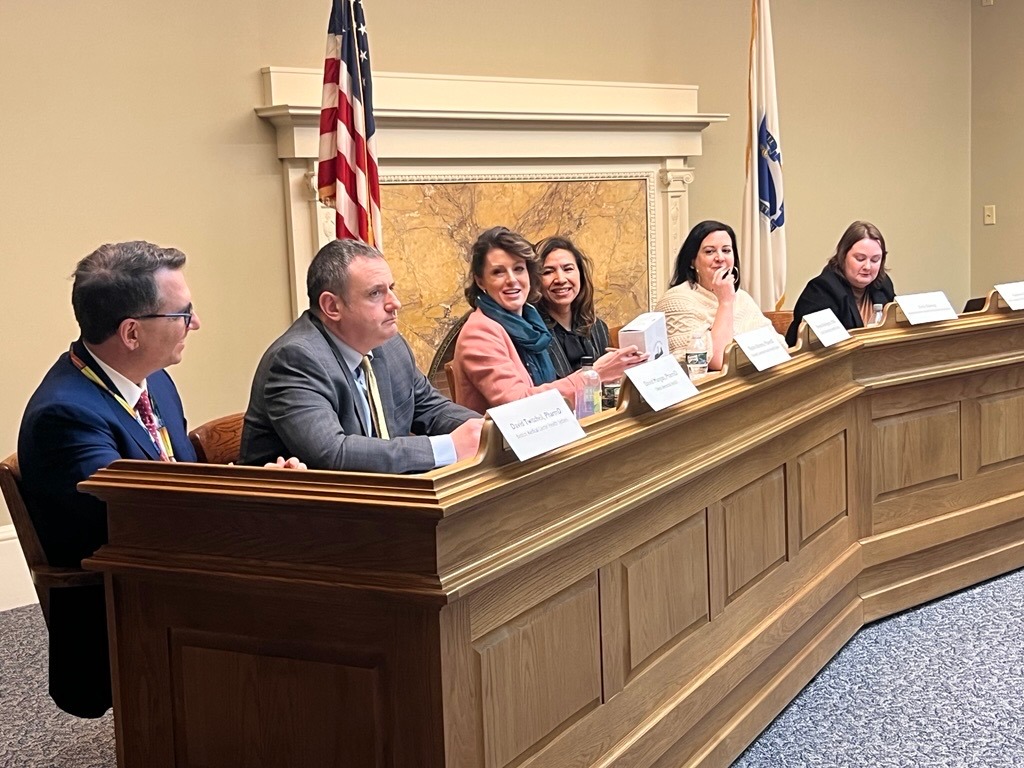
Giving their perspective on the issue were (from left to right in photo above) David Twitchell, senior vice president & chief innovation officer, Boston Medical Center; David Mangan, chief pharmacy officer, UMass Memorial Health; Ryann Abrams, director of pharmacy, Greater Lawrence Family; and Brenda Rodriguez, CEO, Lynn Community Health Center. MHA’s Vice President of Government Advocacy & Public Policy Emily Dulong moderated the panel and at far right Katherine O’Reilly, senior director, public policy and advocacy at the Massachusetts League of Community Health Centers provided expert analysis on the issue.
As was stressed repeatedly during the presentation, savings from drug discounts to health centers and hospitals is, as Lynn Community Health Center Rodriguez said, “integral and inseparable from what we do.” The money “is not extra revenue” and it does not cost the state or taxpayers anything.
MHA and the Massachusetts League of Community Health Centers provided attendees with this informational handout.
The effort at chip away at 340B takes many forms. In January, Eli Lilly and Company informed all covered 340B entities that it was instituting a new policy that would require the entities to submit claims for all dispensations of all Lilly drugs regardless of the setting. A letter from the American Hospital Association to the Health Resources and Services Administration objected to the sweeping policy and explained how the new data requirements “would be especially burdensome, if not impossible” to comply with. Last week, Novo Nordisk announced a policy identical to Lilly’s. To date, HRSA has not responded to AHA’s concerns over the drug companies’ actions.
Senator Pavel Payano (D-Lawrence), who spoke at the information session, along with Rep. Daniel Cahill (D-Lynn) have co-sponsored An Act Prohibiting Discrimination Against 340B Drug Discount Program Participants (H.1107/S.819), while Senator Brendan Crighton (D-Lynn) and Rep. Kate Lipper-Garabedian (D-Melrose) have co-sponsored An Act to Protect 340B Providers in the MassHealth Program (H.779/S.845).
Should the State Take Norwood Hospital Property?
When Steward Health Care collapsed, the state and local hospitals stepped in to keep six of eight Steward hospitals up and running.
Rhode Island-based Brown University Health purchased Morton Hospital in Taunton and Saint Anne’s Hospital in Fall River. What is now known as Merrimack Health purchased the two former Holy Family hospitals in Haverhill and Methuen, and Boston Medical Center Health System is now operating Boston Medical South in Brockton and Boston Medical Center Brighton. Carney Hospital in Dorchester did not receive a bid and closed, as did Nashoba Valley Hospital in Ayer, although UMass Memorial Health is building an emergency care facility in Groton that is expected to open in early 2027.
Not subject to the Steward rescue scenario was Norwood Hospital, which Steward operated until the hospital was closed in 2020 following a flood. It was demolished in 2022 and construction on a new facility began in 2024, but quickly ended following Steward’s collapse. The situation was complicated by the fact that Steward had sold its hospitals’ properties to Medical Properties Trust.
Ever since Norwood Hospital closed, Rep. John Rogers (D-Norwood) and Sen. Michael Rush (D-West Roxbury), along with a host of local officials, advocates, and U.S. Rep. Stephen Lynch (D), among others, have been pressing for the hospital to reopen in some way or the other. Most recently, Rogers and Rush filed by joint petition H.5047, An Act Authorizing the Division of Capital Asset Management and Maintenance to Take by Eminent Domain Certain Land in the Town of Norwood. The bill says an outright taking of the uncompleted hospital and land is necessary “for the purpose of ensuring access to healthcare for the public.”
Providing Post-Hospital Care to the Homeless
The latest report from the state’s Center for Health Information and Analysis (CHIA) confirms some known healthcare “truths” while Many people discharged from a hospital fortunately can return to their homes and have the support of family or friends, or can receive care in a skilled nursing facility or at home. But people who are homeless and discharged from hospitals oftentimes do not have needed support or shelter, which can result in their conditions worsening, their readmission to the hospital, and rising costs throughout the system.
In 2023, using money from the pandemic-era American Rescue Plan Act, MassHealth created the Medical Respite Pilot program that was meant to provide short-term (180 days) residential care and supportive services to homeless people discharged from hospital settings. The pilot ran through 2025. Now a new study of the pilot from forHealth Consulting at the UMass Chan Medical School has found that the program was successful.
Researchers found that participants (who tended to be older males) spent an average of 94 days in respite programs and about 73% of them did not return to homelessness. Program participants also had statistically significantly fewer behavioral health–related inpatient admissions and 30-day hospital readmissions.
“After joining the program, program participants appear to have shifted from emergency or acute care (e.g., inpatient, emergency room) to regular and preventive care (e.g., outpatient, pharmacy),” the researchers wrote. “Within a few months of program entry, participants saw a reduction in total healthcare cost compared to a matched comparison group of non-participants.”
Due to the success of this pilot, homeless medical respite services are now available to any eligible MassHealth member who is enrolled in any managed care plan, as well as those who are in fee-for-service. Members may be eligible if they are 18 or older and experiencing homelessness.
MHQP: Which Primary Practices Scored High?
Massachusetts Health Quality Partners (MHQP) has released the results of its 2025 Patient Experience Awards, which honors primary care practices that achieve the highest scores from their patients on MHQP’s annual Patient Experience Survey.
The survey, now in its twentieth year, is a collaboration between MHQP, health plans, and provider groups. The 2025 results were collected from 4,036 primary care clinicians at 876 practices across the state.
Practices were assessed on 10 performance areas: patient-clinician communications; how well clinicians know their patients; ease of access to care; empowering patient self-care; office staff professional excellence; patients’ trust in their clinicians; assessment of patient behavioral health issues (adult practices only); coordinating patient care (adult practices only); pediatric preventive care (pediatric practices only); and assessment of child development (pediatric practices only). See the winners here.
Transition: Tabb Leaving BILH
Kevin Tabb, M.D., the president & CEO of Beth Israel Lahey Health since 2019, announced last week he is leaving the post in 2027 after his successor is chosen. Before leading BILH, the second largest system in the state, Tabb was CEO of Beth Israel Deaconess Medical Center for eight years. He also chaired the MHA Board of Trustees throughout a challenging 2024 when the Massachusetts system contended with the Change Healthcare cyberattack, Hurricane Helene’s destruction of a major supplier of IV solutions, and the bankruptcy of Steward Health Care. The BILH system that Tabb helped create now consists of 14 hospitals and 42,000 employees, including more than 4,800 physicians. The system recently announced a new partnership with Dana-Farber Cancer Institute. Last Wednesday, Governor Maura Healey said of Tabb, “During times of crisis, from the Marathon bombings to the COVID-19 pandemic, Kevin has always stepped up to support the people of Massachusetts. I’ve had the privilege of working with him for many years and have seen firsthand how he leads with both compassion and resolve. Kevin’s leadership has strengthened healthcare across our state, and I’m grateful for his partnership and service.” Tabb, 62, said he is not retiring from work, but has not decided on his next career move. The BILH Board of Trustees said the nationwide search for his replacement could take 8 to 10 months.