

 Massachusetts Health & Hospital Association
 Budget Amendments, Prior Auth Regs, and more…
INSIDE THE ISSUE
> The Senate’s State Budget
> Prior Authorization Regulations
> Medicaid Hospital-at-Home Programs
> INNOVATION SERIES: Southcoast Health
> Home Health, Hospice Moratorium
> Transition at CHIA
MONDAY REPORT
Focus Turns to State Budget as Formal Session Nears Closure
This week, the State Senate begins its deliberations on the FY2027 budget proposal the chamber’s Committee on Ways & Means released two weeks ago on May 5. Debate on the budget and the 1,158 amendments to it that were filed last week is expected to wrap up by week’s end. A completed state budget has to be signed by the end of the fiscal year on June 30.
Another big deadline, just nine weeks away, is the close of the formal legislative session on July 31, 2026. Typically, major bills must pass by the July 31 deadline, as it is rare to get the “unanimous consent” required to pass a bill during the informal legislative sessions that run from August 1 to the end of the year.
MHA-backed amendments to the Senate’s version of the state budget include one that would redirect $37.5 million from the Commonwealth Federal Matching and Debt Reduction Fund to the Health Safety Net Trust Fund; it would also allow federal matching revenues for the transfer, potentially providing a total of $75 million in additional Health Safety Net relief in FY2027. The amendment is similar to the one that the House approved in April.
Another amendment receiving MHA support would prevent further erosion of 340B benefits to hospitals and other eligible covered entities through the MassHealth program. In April, MassHealth proposed regulations to eliminate coverage for all prescription drugs that are acquired through the 340B Drug Pricing Program. This will cause MassHealth in most cases to reimburse hospitals less than the cost of acquiring drugs they dispense to patients. The discounts achieved through the 340B program provide much-needed financial benefits to hospitals and their patients at a time of prolonged financial stress, yielding savings for their operations that would otherwise operate at a loss in many cases. These benefits – drawn directly from drug company profits – allow healthcare providers to stretch their resources to, among other things, subsidize underpayment by MassHealth and Medicare for medical services. The amendment to be debated this week would help stem the potential losses.
While a core legislative focus in the coming weeks will be on getting a budget to Governor Maura Healey’s desk, other bills that have been debated over the past two years await action before the July 31 session deadline. Among these is An Act Requiring Healthcare Employers to Develop and Implement Programs to Prevent Workplace Violence, which the House passed in November 2025 and which pends before the Senate in S.1718. The bill does not impose onerous costs on the healthcare system but does provide a commitment to every frontline worker to provide a safe working environment for them. It came about after more than a decade of similar, but competing proposals were put aside and a unifying agreement was reached between MHA, the Massachusetts Nurses Association (MNA), and 1199SEIU Massachusetts. The bill requires all hospitals to complete facility-specific risk assessments and implement comprehensive violence prevention programs tailored to those findings; and engage frontline staff in developing assessments and prevention plans, ensuring workforce-informed training, and making written plans available to all employees and labor organizations. The bill strengthens enforcement through DPH licensing requirements, regular reporting, and enhanced job protections for workers, including additional paid leave for employees who are assaulted.
Final Regulations on Prior Authorizations Released
Last Thursday, the Healey-Driscoll administration rolled out the final regulations that will implement the policy announced earlier this year to eliminate prior authorization requirements for a wide variety of healthcare procedures and drugs.
The Division of Insurance, under the leadership of Commissioner Michael Caljouw, in January released draft regulations to eliminate prior auth for many services, including emergency and urgent care, primary care, chronic care, occupational and physical therapy, substance use disorder treatment, post-acute care services provided on weekends and holidays, and certain prescription drugs. During the public comment period, additional provisions were added to eliminate prior authorization for radiology imaging used after a cancer diagnosis to determine the stage of the cancer or to determine the best treatment method, as well as to ensure that prior authorization approval for chronic conditions, like cancer, continue throughout the entire course of treatment.
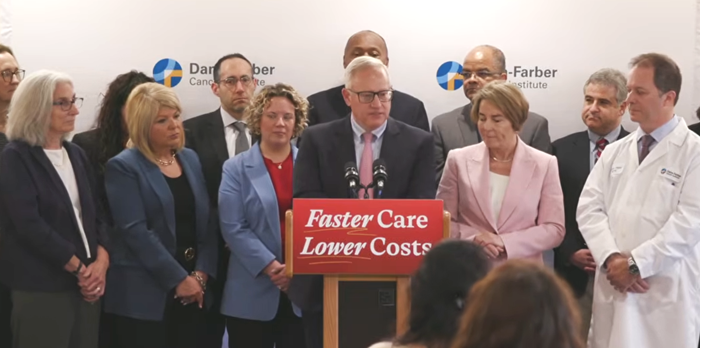
“When your doctors say you need it, you’re going to get it,” the governor said at a press conference last Thursday at Dana-Farber Cancer Institute. The governor called the reforms the strongest revision of prior authorizations in the U.S., and she noted that a key provision of the Massachusetts plan is to ensure that when a patient changes plans they won’t need to get approvals for the medications and treatments for which they’ve already been approved.
“These reforms will ensure Massachusetts residents get the care they need when they need it,” Commissioner Caljouw said. “We would not be here without the collaborative approach of stakeholders towards the crafting of these meaningful changes.”
Caljouw said the regulations will take effect on June 5, but that DOI will hold forums through July to ensure all parties are up to speed on the changes. That will be followed by insurers filing compliance plans that DOI will review; patients will see results by year’s end.
Streamlining the prior authorization process has been a longtime priority for the provider community. MHA, along with the Massachusetts Medical Society and Health Care for All have supported legislation filed by Sen. Cindy Friedman (D-Arlington) and Rep. Majorie Decker (D-Cambridge), that would reduce unnecessary authorization requirements. “MHA and our members commend Commissioner Caljouw and his team for the many months of thoughtful work and determination that went into these regulations,” said MHA President & CEO Steve Walsh. “We are also deeply grateful to the entire Healey-Driscoll administration for advancing progress on an issue that, for too long, has delayed patients’ access to timely care, compounded the strain on healthcare workers, and contributed to rising healthcare costs. We are especially encouraged that DOI will be empowered to monitor and refine the state’s approach to prior authorization over time. These regulations represent an important step forward and have the potential to meaningfully improve affordability and access for patients across the commonwealth.”
Hospital at Home Can Work – for Everyone
Hospital at home programs – which bring inpatient-level care to patients inside of their homes – can help improve health outcomes in patients that are primarily covered by Medicaid, a new study in the Journal of American Geriatrics Society has found.
Hospital-at-home (HaH) programs gained prominence during the pandemic and their Medicare reimbursements were recently extended through the Consolidated Appropriations Act of 2026. But some policymakers have questioned whether HaH programs could work with the historically marginalized populations served by Medicaid. One North Carolina study suggested that the state’s Medicaid populations may benefit more from traditional inpatient care over HaH care.
The Massachusetts Medicaid program – MassHealth – was one the first state programs to reimburse acute care hospitals for their hospital-at-home programs. The recent Journal of American Geriatrics Society study – “Acute Hospital Care at Home in Massachusetts Medicaid” – tracked nearly 1,000 HaH Massachusetts patients and found low rates of mortality, readmission, and discharge to skilled nursing facilities.
“Our experience demonstrates that patients with Medicaid have clinical outcomes that are reassuring and similar to other [HaH] populations,” the authors wrote. “Further, the capacity of [HaH] teams to provide acute medical care while also identifying and simultaneously addressing previously unrecognized health-related social needs may contribute to improved patient care.”
The authors – who included researchers from MassHealth, UMass Memorial Medical Center, Mass General Hospital, and Brigham and Women’s Hospital, among others – said the recent federal five-year extension of the [HaH] program, along with their study conclusions, provides assurances that such program can work. “Our findings should facilitate adoption of [HaH] by state Medicaid agencies that currently do not cover [HaH] services,” they wrote..
Massachusetts Healthcare Innovations
The Commonwealth of Massachusetts is an innovation leader in a variety of fields from early manufacturing advances, to public education leadership, and, especially, groundbreaking healthcare discoveries.
Massachusetts hospitals and health systems always have led the way in creating lifesaving clinical procedures to innovative models of care delivery. And for 90 years, MHA has stood alongside its member organizations as they advance a legacy of innovation, driven by a shared commitment to improving patient lives, empowering caregivers, and strengthening communities. In recognition of these innovations, MHA has compiled stories from hospitals and health systems across the state, and will feature them on this webpage and periodically in Monday Report.

Southcoast Health: Unprecedented Times, Innovative Solutions
When COVID-19 struck, Southcoast Health knew that the most effective way to get people tested was to meet them where they were – community centers, local businesses…even fishing boats and piers.
New Bedford is one of the country’s most important fishing centers. Roughly 390 million pounds of seafood a year come through the city. A third of that is fished locally, while the rest comes from other countries and is processed there. With so many employees working in close contact, the docks and processing plants could have become a COVID “superspreader” site, but Southcoast Health partnered with the city’s health department on a testing initiative to turn mobile units normally used as flu clinics into free COVID-19 testing centers that could test processing plant employees and meet ships at the pier.
With results available in 24 to 48 hours, Southcoast healthcare workers could vet crew members during the two- to three-day windows they remain on shore between fishing trips. This testing program was so innovative and successful that it was covered by National Geographic magazine.
When vaccines became available, Southcoast Health adopted a similar approach, meeting people where they were with convenient vaccination clinics across the region. Ultimately, Southcoast administered 114,000+ vaccine doses in the first year.
CMS Halts New Home Health, Hospice Programs
The Centers for Medicare & Medicaid Services (CMS) last Wednesday announced it was halting, for six months, all new Medicare enrollments for home health agencies and hospices.
CMS, working with the administration’s Anti-Fraud Task Force, said the moratorium was needed to stop “bad actors” in the hospice and home health space from “exploiting some of our most vulnerable Medicare patients and stealing money from the American taxpayer.”
CMS said it would step up its investigations and “deploy advanced data analytics” to accelerate the removal of hospice and home health agencies “that are suspected of committing fraud.”
“In addition, the moratoria will apply to all applications for initial Medicare enrollment and certain changes in majority ownership, which are frequently used to obscure control by bad actors,” CMS wrote in a media release. “The moratoria will not impact current enrollments, and existing providers can continue to deliver services to Medicare beneficiaries.”
Transition
Governor Maura Healey, Attorney General Andrea Joy Campbell, and State Auditor Diana DiZoglio have announced the joint appointment of Andrew Jackmauh as executive director of the Center for Health Information and Analysis (CHIA). Jackmauh has served as acting executive director since January and has been at CHIA since its inception in 2012, serving as chief of staff from 2018 to 2026. Prior to joining CHIA, he worked at the Executive Office of Housing and Economic Development. Jackmauh earned a BA from the University of Massachusetts Boston and a Master of Public Administration from UMass Boston’s McCormack Graduate School of Policy and Global Studies.