

 Massachusetts Health & Hospital Association
INSIDE THE ISSUE
> Allied Health Shortages
> $1.1 Billion in Community Benefits
> MHA’s Workforce Summit
> End of Session
> HPC Funds Hospital-to-Home Programs
> State Directed Payments
> Rural Health Advisory Council
MONDAY REPORT
Report Details Breadth of Key Workforce Shortages
A report released last week at MHA’s Workforce Summit shows that employer demand far exceeds the supply of workers in six key nursing and allied health fields, which will have “substantial and unsustainable consequences” for the state’s healthcare sector and economic opportunity.
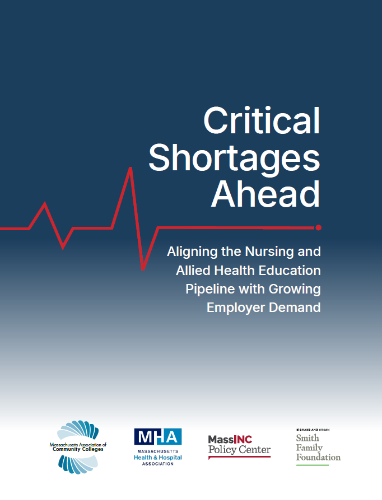
Critical Shortages Ahead: Aligning the Nursing and Allied Health Education Pipeline with Growing Employer Demand was produced in partnership by the MassINC Policy Center, MHA, the Massachusetts Association of Community Colleges, and the Richard and Susan Smith Family Foundation.
The six target occupations featured in the report are: licensed practical nurses, associate degree registered nurses, medical/clinical laboratory technicians, respiratory therapists, surgical technologists, and radiologic technologists/radiographers. The report data was collected from surveys of certificate and degree programs associated with the six target occupations, as well as surveys of human resources leaders from acute care hospitals and long-term care providers, supplemented by data collected from federal and state sources.
“Massachusetts is world-renowned in the field of healthcare, and yet we are facing a dire workforce shortage in some of the most critical healthcare occupations,” said William Heineman, president, North Shore Community College and chair of the Community College Council of Presidents.
While the shortage of workers grows, so has the desire of students to enter the healthcare field; the number of qualified students seeking education for these occupations from Massachusetts community colleges exceeds expected programmatic capacity by at least two to one, according to the report. Community college programs for the six occupations currently draw about 4,500 applicants, but they only have the capacity to enroll around 2,200 students. The imbalance is most severe for rad techs, where programs have five qualified applicants for each available seat. Also of concern, large geographic gaps in education capacity exacerbate the workforce shortage in some parts of the state, the report found.
Educators and providers identified three key obstacles to expanding enrollment to meet student demand: insufficient clinical placements, faculty and program leadership shortages, and state regulatory barriers for nursing.
The inability to educate and train the next generation of healthcare workers is leading to three troubling developments, according to the report. First, “In occupations facing severe labor shortages, persistent turnover creates a costly cycle that undermines the quality, accessibility, and affordability of care.” That leads to the second problem – the high cost of temporary labor. “Survey respondents for both acute and long-term care organizations reported a combined $232 million in annual spending on temporary agency staff,” the report notes. “Extrapolating from these figures to all Massachusetts employers, the actual agency spend for these six occupations alone likely exceeds $450 million.” Finally, the critical shortages of key healthcare workers results in the difficult to quantify “lost economic opportunity” for students, who don’t have a chance to participate in meaningful, well-paying jobs and often don’t have a fallback position.
“These nursing and allied health professionals are vital members of both acute and post-acute care teams, and essential to hospital operations,” said Kim Stevenson, MHA’s director of workforce and clinical affairs. “The joint report gives us a first-of-its-kind look at the gaps and the barriers in creating these positions, and recommendations for how we can work collectively to find solutions to bring better balance to the supply and demand for caregivers.”
While the report acknowledges the current, ongoing efforts to build the workforce, it concludes that more action is needed. Specifically, the report calls for increasing the number of clinical placements and clinical educators by, among other things, addressing faculty compensation; creating a state regulatory environment supportive of expanding nurse education capacity; and developing “longitudinal data systems” to follow students through education, licensing, and into the workforce.
“Solving the allied health workforce crisis will require involvement and commitment from all relevant stakeholders,” according to the report. “To that end, we are strongly urging leaders from across state agencies, education, healthcare employers, and other key stakeholders to convene a time-limited task force to collaboratively strategize and implement solutions to the challenges presented in this report.”
Hospital Community Benefits in FY25 Total $1.1 Billion
In a tough healthcare economy in which the majority of hospitals and health systems are experiencing negative operating margins – and with larger deficits expected in the coming year due to federal cuts – the Massachusetts hospital community nonetheless contributed $1.1 billion in total “community benefits” expenditures, of which $120 million was spent on free and discounted care, according to the Massachusetts Attorney General’s Office. The $1.1 billion outlay in Fiscal Year 2025 was the largest hospital community benefits amount ever reported.
Hospital-funded community benefit programs, which are undertaken by facilities after an extensive outreach process with their local community partners, fund the real-time service needs of the towns and cities they serve. Hospitals have created mobile health vans, nutrition programs in schools, workplace development initiatives, senior care outreach, addiction prevention services, and much more all at no cost to the residents being served, health insurers, or the government. The preventative services provided by many of these programs helps individuals avoid the need for more serious – and expensive – medical care down the line.
“Far too many communities continue to experience inequities in access to healthcare, and the Community Benefits program is an important way that hospitals and HMOs can invest in improving public health,” said Attorney General Andrea Joy Campbell. “I appreciate all Massachusetts hospitals and HMOs that are using these programs to expand access to services and address the social and economic factors that shape health outcomes.”
Among the programs the AG cited in the recent report were:
- New England Baptist Hospital’s Project Search High School Transition program, which provides a one-year, school-to-work program for youth with significant disabilities. The youth receive real-life work experience, a weekly stipend, and training in employability and independent living skills to help them make successful transitions from school to productive adult life.
- Emerson Health’s Home Care Visit program that enhances community members’ ability to navigate the healthcare system. Program staff visit recently discharged patients and conduct patient evaluations, provide care maintenance information, and share community resources to reduce hospital readmission.
- North Adams Regional Hospital’s Operation Better Start, which provides free services to clients and families to address health issues, including obesity, failure to thrive, eating disorders, hypertension, food allergies, gastrointestinal disorders, high cholesterol, pre-diabetes, diabetes, and sports nutrition. A nurse practitioner works directly with a registered dietitian and the patient’s family to generate a comprehensive treatment plan with individualized, achievable goals.
“Growing cost and affordability pressures, resource shortages, and the expanding population of uninsured patients are all putting the hospital community in Massachusetts – and subsequently the people it serves – in a very precarious position,” said Steve Walsh, MHA’s president & CEO. “But because they never turn their backs on their communities and they are driven to advance essential healthcare, hospitals expend these community benefit investments. The stabilizing economic and ethical forces that hospitals provide to our state are shown each year in these reports.”
All Massachusetts Community Benefits reports, including information about the goals and impact of each program, are available on the AGO’s Community Benefits webpage.
A Statewide Summit on Workforce Challenges
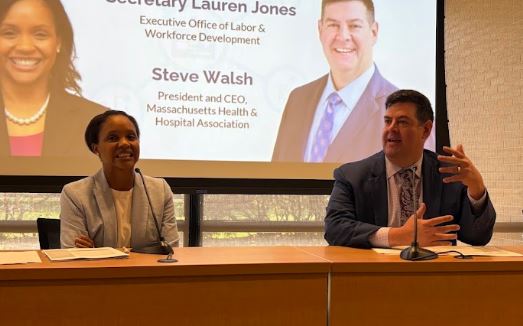
Nearly 200 people attended MHA’s annual Workforce Summit last Wednesday at the association’s Burlington offices. Aside from MHA’s Annual Meeting in January and the popular Annual Women Leaders in Healthcare Conference each December, the workforce conference is the best attended event of the year.
This year’s conference kicked off with a “fireside chat’ between Secretary Lauren Jones of the Executive Office of Labor & Workforce Development and MHA President & CEO Steve Walsh (see photo). Speaking of the state’s effort to build the workforce, Jones said, “What we are cultivating and what we aim to continue to cultivate is the best talent marketplace for employers to connect to talent and for talent to connect to opportunity. And we’re modernizing some of our systems to do exactly that.”
The report on critical shortages in the healthcare workforce (see story above) was presented at the forum.
Session Ends Friday; Attention Turns to Conference Committees
The Massachusetts legislative session ends this Friday, July 31, but unlike past years, new rule changes that the legislature enacted allow debate to continue to the end of 2026 on any bills that both branches have passed and that have been placed in conference committee.
One such piece of legislation is the workplace violence prevention bills that the House and Senate approved. Last Thursday, the House assigned the following representatives to that conference committee: Michael Day (D-Stoneham), Brandy Fluker-Reid (D-Boston), and Hannah Kane (R-Shrewsbury). As of Monday Report’s deadline, the Senate conferees had not been named, nor had the conferees for the economic development bills that the branches had passed.
HPC Distributes PATHways Hospital-to-Home Funding
The Health Policy Commission announced last Thursday that it was distributing $1.38 million to seven acute care hospitals to support new or existing hospital-to-home programs. Some of these hospitals had initiated programs with federal ARPA funding during the pandemic, but funding lapsed.
Berkshire Medical Center, Boston Medical Center, Holyoke Medical Center, Lowell General Hospital, and UMass Memorial HealthAlliance – Clinton Hospital each received $210,000, while MelroseWakefield Healthcare received $124,700, and Southcoast Health System $201,424.
In April, the HPC opened nominations for the Promoting Appropriate Transitions to Home (PATHways) investment program that is aimed at streamlining patient discharges to home care instead of skilled nursing facilities or other institutional settings.
MHA has been tracking the “throughput” problem for years, tallying the number of patients stuck in acute care hospitals because they are unable to transition to post-acute rehabilitation. That stuck patient number at times reaches 2,000 patients daily. The Massachusetts Transitions from Acute Care to Post Acute Care Task Force amplified the problem in a 2025 white paper and recommended a PATHways-type program in addition to a number of other initiatives.
“The seven new PATHways hospitals and their partners will connect patients with the support they need to discharge from hospitals and receive care in their homes and communities – a mission that is more critical now than ever, with estimates that on average 2,000 residents ready for discharge remain hospitalized each day,” said HPC Executive Director David Seltz.
MHA Says CMS Payment Proposal Harms Hospitals
MHA last week wrote to the Centers for Medicare and Medicaid Services (CMS) objecting strongly to a proposed rule that, among other things, would cap Medicaid State Directed Payments (SDP) to 100% of Medicare rates as opposed to the current practice of setting the rates at the significantly higher Average Commercial Rate ceiling.
The federal government’s revamping of SDPs is being proposed to fulfill an element of the One Big Beautiful Bill Act (OB3), although MHA and other provider groups contend that CMS’s proposed rule goes beyond Congress’s intent for OB3. SDPs, which have existed since 2016, allow states flexibility in how they direct Medicaid Care Organization (MCO) funds to providers and for specific services.
“Medicaid SDPs are essential components of the financing that drives payment and delivery system reforms, funds quality incentive programs, and ensures that access to services is sustainable,” MHA wrote. “In turn, SDPs allow healthcare providers and the government to deliver on their shared goal of high-quality care for every patient.”
But the federal proposal disrupts that process, handcuffing states on how they distribute the funds, and harming those facilities that serve a high proportion of Medicaid patients, as well as pediatric and cancer hospitals that receive payment adjustments unique to their populations, MHA said.
“This proposed approach translates into an effective federalization of Medicaid reimbursement for healthcare services and devalues state flexibility and local management of scarce healthcare resources,” MHA wrote. “If the proposed rule moves forward as drafted, it will ultimately create federal overreach into local healthcare decision-making in a way that is administratively burdensome, runs counter to the administration’s stated goals, and financially damaging to states, healthcare providers, and ultimately patients.”
MHA estimates the SDP limits will reduce Massachusetts hospital managed care supplemental payments by 10% per year during a phase-down period that by the third year will add up eventually to a $600 million annual reimbursement cut. Those reductions would layer on top of other major losses hospitals are facing as Health Safety Net deficits skyrocket, largely as a result of federal eligibility changes, and as the 340B drug pricing program faces persistent attacks.
Rural Health Advisory Council Named
Last Thursday, the Healey-Driscoll administration announced the members of the Rural Health Transformation Program Community Advisory Council, to provide guidance as the state distributes the Rural Health Transformation Program (RHTP) funding from CMS.
At the end of December, Massachusetts was awarded $162 million that will be distributed to entities across the state. The Rural Health Transformation Program is operated by the Executive Office of Health & Human Services, led by Project Director Eliza Lake, and Director of Rural Health Transformation Kirby Lecy. It is anticipated that the state will issue requests for proposals in the coming weeks, and will hold information sessions regarding the state’s vision and structure for the rural programming.
MHA’s Senior Director of Virtual Care and Clinical Affairs Adam Delmolino will have a seat on the newly formed advisory council. See the full membership here.