

 Massachusetts Health & Hospital Association
 Shutdown Averted, A New Era of Cost Pressures
INSIDE THE ISSUE
> Continuing Resolution
> A New Era of Pressures
> Addressing Sepsis
> Community Health Award
> Labor Day
MONDAY REPORT
Federal Funding Bill Delays Controversial Research Rule
President Trump signed a continuing resolution (CR) last Wednesday that will fund the federal government through December 11, avoiding a shutdown heading into midterm season. The U.S. House of Representatives passed the CR on Tuesday after the Senate had approved its own version in early July.
Of note to the healthcare and research communities, the CR delays a rule that would alter the process through which federal grants are awarded. The rule published by the White House Office of Management and Budget (OMB) in May would, among other changes, allow senior political appointees to sign off on grants (as opposed to primarily peer reviewers and scientists); restrict research in areas deemed related to DEI and “gender ideology,” and expand the government’s authority to change the conditions of – or terminate – an award mid-stream.
Those changes prompted immediate concerns from research institutions – including those within the healthcare sector, which relies heavily on federal funding for medical studies.
“Hospitals and health systems cannot responsibly recruit principal investigators, launch multiyear clinical studies, expand residency programs, establish rural outreach initiatives or build community-based behavioral health programs if there is significant uncertainty regarding whether funding conditions may materially change after an award has been made,” the American Hospital Association wrote to OMB Director Russell Vought in July. “Increased uncertainty also makes it more difficult for governing boards and institutional leadership to commit matching funds or make complementary capital investments that often maximize the value of federal grants.” MHA and the Conference of Boston Teaching Hospitals sent a letter to OMB in July echoing those concerns.
The rule was originally scheduled to go into effect on October 1 and is now tied to the CR’s December 11 expiration.
Connecting the Symptoms: A New Era of Cost Pressures
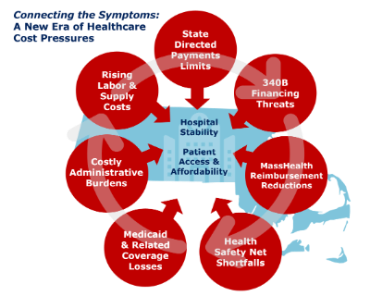
Massachusetts hospitals and health systems are bracing for the most daunting collection of financial pressures in their history. Throughout August, Monday Report’s “Connecting the Symptoms” series highlighted just a few of those large-scale factors – some of which have yet to be fully explored in the public eye – in an effort to explain how they work, their troubling implications for patient care, and why they must be considered in conjunction with one another as the state continues its collective focus on healthcare cost, access, and affordability.
The full “Connecting the Symptoms” series is compiled on this webpage, with a summary below:
- State Directed Payments: $600 Million in Annual Losses
Through the One, Big, Beautiful Bill Act, Massachusetts hospitals are slated to lose hundreds of millions each year through restrictions on “State Directed Payments” – which for a decade have allowed states to direct how Medicaid managed care organizations reimburse providers under certain conditions. MHA has warned that these funding losses, used primarily to help safety net hospitals, will cause “irreparable harm” to the broader healthcare system.
- 340B: Threats to an Essential Lifeline
The federal 340B Drug Pricing Program allows hospitals and community health centers to purchase outpatient medications directly from pharmaceutical companies at significant discounts and embed the savings throughout vital care services and in their communities. It has become such an essential lifeline for the day-to-day operation of safety net hospitals and health systems that the recent attacks on it by pharmaceutical companies – as well as new, erosive policies from state and federal government – are now of urgent concern to providers. - The Medicaid RFA: Access & Administrative Challenges
The MassHealth Acute Hospital Request for Applications (RFA) is the primary annual contractual agreement and policy framework between MassHealth and Massachusetts acute care hospitals. MHA has warned that numerous proposed changes in the forthcoming RFA – including the elimination of hospital reimbursement for telehealth medical visits, a post-payment utilization review for outpatient claims, and a “72 hour rule” that could lead to further reimbursement reductions – will further challenge healthcare access and increase administrative burdens. - The Health Safety Net: A Fraying Program
Massachusetts’ Health Safety Net program, which funds the care that low-income uninsured and underinsured patients receive at local hospitals and community health centers, is now facing record deficits of more than $200 million a year. For hospitals, which bear the sole responsibility for covering those shortfalls, the fraying Health Safety Net poses one of the most immediate threats to their financial stability. While local policymakers have stepped up to deliver short-term relief, hospitals are now working with the state to explore necessary changes to keep the program sustainable. - Other systemic cost drivers are already affecting hospitals and health systems today. Those include fast-rising labor and supply costs, more than $1 billion in unnecessary administrative burdens each year, and treating sicker patients – many of whom cannot be discharged in a timely fashion. Those factors, in part, led 70% of hospital health systems (which include affiliated physician practices) to operate in the red through March of this year.
One of the few mechanisms for supporting the state’s healthcare system as it prepares for the massive changes from OB3 and other federal policies is through the 1115 Medicaid waiver, which the state is currently drafting and will submit to CMS later this year.
“There is a five-alarm fire brewing around the corner for our healthcare system, but there are steps we can take as a commonwealth to ease the flames,” said MHA Senior Vice President of Healthcare Finance & Policy Dan McHale. “The upcoming waiver is a precious opportunity to mitigate some of these enormous losses, as is our state’s ongoing examination of root cost drivers and sustainable affordability solutions. We will continue our collaborative work with local policymakers to quantify these issues and ensure we are doing everything in our power to protect healthcare organizations, caregivers, and patients.”
Sepsis Awareness Month: A Powerful Local Partnership
Sepsis is a serious – often life-threatening – condition in which the body’s extreme reaction to an infection can quickly lead to disorientation, organ failure, and death. It affects more than 1.7 million U.S. adults each year, 350,000 of which either die during hospitalization or ultimately require hospice care.

While hospitals’ focus on preventing and treating sepsis is a daily imperative, September serves as an opportunity to raise broader awareness and spotlight resources around the condition. The Sepsis Alliance is providing a range of educational and creative materials to mark Sepsis Awareness Month’s 15th year. MHA regularly updates its PatientCareLink website with updated resources and has contributed to emergency care guidance developed by the Massachusetts Sepsis Consortium.
Earlier this year, Saint Anne’s Hospital launched a partnership with the Somerset Fire Department to improve survival outcomes for patients experiencing sepsis before they arrive at the hospital. The program focuses on rapid identification and treatment of sepsis at first EMS contact. Paramedics screen patients upon arrival, and those meeting clinical criteria receive immediate antibiotics, accelerating care during the most critical window of illness.
“This partnership extends the hospital’s capabilities into the field and gives patients a critical head start in treatment,” said Ian Dennen, R.N., director of emergency services at Saint Anne’s.
Apply for AHA’s Community Health Award
Applications are open for the American Hospital Association’s 2027 Dick Davidson NOVA Award, which recognizes hospitals’ excellence in improving community health status alongside local partners.
Hospitals are encouraged to apply if their program has been operational for at least two years, has a documented impact within the community, is sustainable and can be replicated in other communities, and improves equity in the community.
The application window closes on October 8. Winners will be recognized at the AHA’s Healthier Together Conference in Anaheim, California next May. Learn more and apply here.
An Essential Sector, an Exceptional Workforce
Labor Day became a national holiday in 1894 under the second Grover Cleveland administration and the nation’s 53rd Congress. 132 years later, as most of the nation enjoys a pause, many of the commonwealth’s 207,000 healthcare workers remain on the job. They are the clinicians who heal bodies and save lives, the support staff who do the quiet work of keeping facilities clean and guiding patients along, and the many others who keep the 24/7 wheels of healthcare moving. MHA and its members are proud to share their gratitude not just through words, but through ongoing efforts to – among other statewide actions – create healthier work environments, keep workers safe, and identify where critical gaps remain.