

 Massachusetts Health & Hospital Association
INSIDE THE ISSUE
> New Data: Expenses Squeeze Hospitals
> Blue Wave/Tsunami
> Senate Supp Budget and 340B
> Insurers, Providers Agree on Faulty 340B Practice
> Baystate Mercy Hospital
> Transition
MONDAY REPORT
Critical Condition: Mass. Patient Care Expenses Have Skyrocketed by 54%
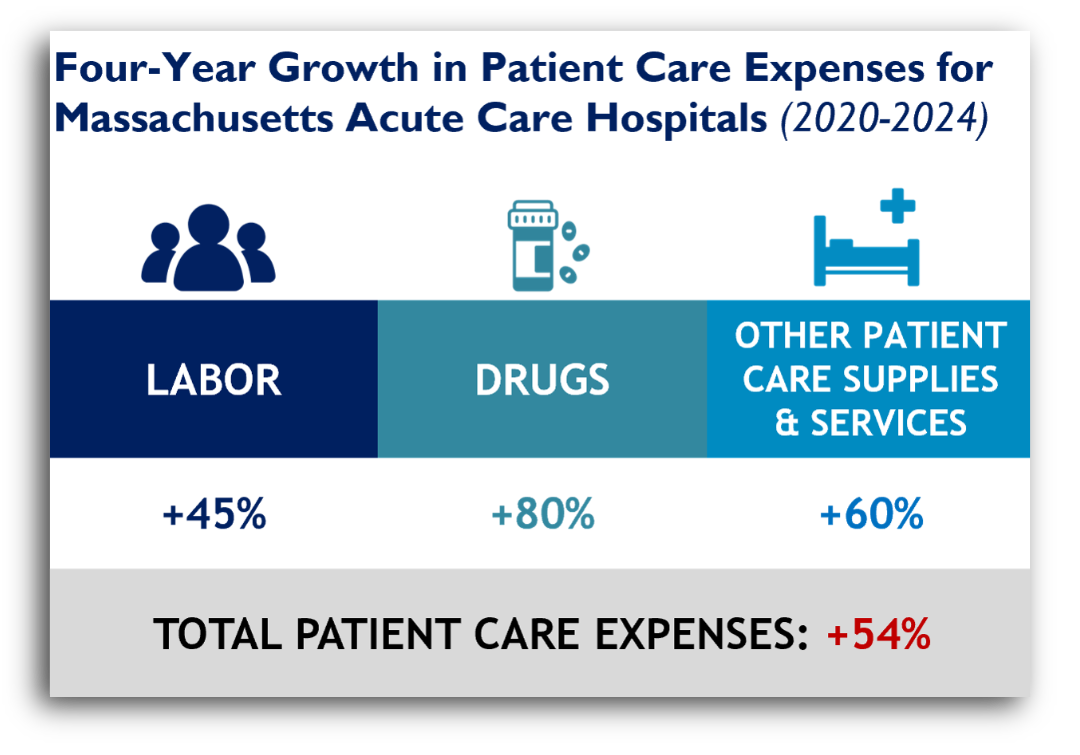
A new MHA report shows that patient care expenses for Massachusetts acute care hospitals have spiked upwards by 54% since 2020.
Those dramatic increases, combined with the billions of dollars now at risk as a result of federal actions, are leading Massachusetts hospitals to make hard decisions, including reducing their workforce and even cutting service lines – all while the sector searches for meaningful affordability solutions.
According to the MHA analysis of the Center for Health Information and Analysis’ (CHIA’s) cost report data, over a period of just four years labor costs for hospitals have risen 45%, drug costs have spiked by 80%, and the cost of all other patient supplies and services have risen by 60%. All totaled, the expenses hospital accrue to care for a patient have risen 54% since 2020.
While nearly all sectors of the Massachusetts economy have experienced increased expenses due to rising labor and supply costs, tariffs, and more, hospitals and health systems – which are usually the largest employers in their communities – are especially vulnerable to the enormous spike in input costs. Because these expenses are essential to maintaining patient care services, hospitals must absorb them to their own financial detriment, leading to the negative or razor-thin operating margins seen today.
The MHA report – Critical Condition: How Mounting Hospital Pressures Put Patient Care At Risk – lays out in very stark detail the worsening strains that are affecting hospitals from multiple angles. While the report details some well-known pressure points that have consistently afflicted hospitals, Critical Condition shows how the compounding pressures can result in reduced access for patients and threatened viability for some providers.

“Our hospitals and health systems are heading down an unsustainable path, with very real consequences for those they care about the most: patients and workers,” said MHA’s Interim President & CEO Mike Sroczynski. “This is an important time for us to be painting a clear picture for the policymaking community. We know pharmaceutical costs are the greatest drivers of healthcare cost growth. We know that come January 1, the process begins where hundreds of thousands will lose coverage, which in turn will grow the Health Safety Net shortfall by $500 million unless drastic actions are taken. Those shortfalls, as has been well documented, are born entirely by hospitals.”
Sroczynski said he hopes the MHA report will call attention to the fact that, as a result of worsening financial dynamics, the current median hospital health system operating margin in Massachusetts of negative 1.5% will only get worse. That negative margin demonstrates that patient care expenses are growing faster than the revenue health systems take in. Without a modest operating margin, hospitals often have little recourse but to lay off staff and cut services.
The One Big Beautiful Bill (OB3) that will result in major coverage losses also affects revenue that hospitals have historically received, such as “State Directed Payments” that have allowed states to direct how Medicaid managed care organizations reimburse providers under certain conditions. The loss of that ability will remove up to $600 million from Massachusetts hospitals’ bottom line by 2030. The federal 340B drug program that has allowed hospitals and community health centers to buy discounted medications from profitable pharmaceutical companies is also at risk due to erosive state and federal policies, and intensive drug company opposition. MHA’s Critical Condition shows how these policies and others put $1.7 billion at risk for Massachusetts hospitals in the next year, and $2.3 billion by 2030.
In addition to the workforce and service line cutbacks that have, and will continue to occur, all Massachusetts hospitals are engaged in cost-cutting efforts, ranging from predictive staffing and smart scheduling technology, to improving supply chain management and leveraging new technologies to limit repetitive finance department tasks and document submission.
But hospitals and health systems have been stressing to policymakers that bold actions are needed to right the healthcare ship, especially as those actions relate to the Section 1115 Medicaid waiver that the state is now constructing. That five-year waiver agreement between the state and federal government over how the state’s Medicaid program, MassHealth, will be funded and operate provides the best option to help financially stabilize the healthcare system as the most disruptive parts of OB3 are implemented, MHA has argued.
“We believe the state has an opportunity and a need to do more in its upcoming waiver proposal to the federal government so as not to leave money on the table,” MHA’s Sroczynski said. “Massachusetts has been a national leader in devising waiver initiatives to both address the healthcare needs of its residents and support the healthcare safety net. We’re hopeful we can work with EOHHS on a bolder approach than is currently being considered.”
Critical Condition also highlights a framework that hospitals and health systems have embraced as they help inform sustainable, meaningful affordability reforms. The “R3” approach – “Repair, Realign, Reimagine” – is intended to support ongoing efforts from the Healey-Driscoll administration and others to bring down costs for patients and businesses. It recognizes that many of the affordability strains being experienced today can be traced back to the financial distress of the healthcare system, unnecessary administrative and regulatory burdens, and the need to change how – and where – care is delivered.
Affordability is the central theme of the Health Policy Commission’s Cost Trends Hearing tomorrow.
What the “Blue Wave” Means for Mass. and Healthcare
Last week’s so-called “Blue Wave/Tsunami” that led to Democrats taking control of Congress, along with many governorships and legislatures across the country, will have some very clear effects on Massachusetts and healthcare in general.
First, Rep. Katherine Clark (D-Mass.), the current Minority Whip in the House, will most likely become Majority Leader, considered to be the second most powerful House position after Speaker, which is expected to be held by current Democratic Leader Hakeem Jeffries (D-N.Y.). Rep. Richard Neal (D-Mass.) will most likely resume chairmanship of the House Ways & Means Committee, through which flows all bills relating to taxation, revenue generation, tariffs, international trade, Social Security, Medicare, unemployment insurance, and public welfare programs. Neal has been a consistent and strong supporter of hospitals and patient access. Rep. Jim McGovern (D-Mass.) is expected to resume as chair of the Rules Committee, another powerful post that controls the path that major legislation takes to the House floor, allowing the majority party to protect its legislative agenda.
Reps. Lori Trahan and Jake Auchincloss, both Democrats, are expected to remain on the powerful Energy and Commerce Committee, which will be especially important as Congress seeks to repeal or delay OB3’s Medicaid changes, and to protect federal medical research grant rules. Senator Ed Markey’s (D) re-election moves him into position for a possible committee chairmanship, which may or may not mean he will cede his work on the Senate’s Health, Education, Labor and Pensions Committee. Sen. Elizabeth Warren (D) is in line to chair Senate Banking. And Massachusetts’ newest Representative is Dan Koh (D), who won the seat formerly held by Seth Moulton. Koh was a former chief of staff for Marty Walsh, both when Walsh served as Boston Mayor and later as U.S. Secretary of Labor. Koh’s father is Howard Koh, M.D., the former Massachusetts Department of Public Health Commissioner under Governor William Weld.
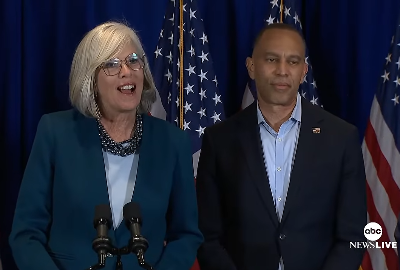
In a media conference last Wednesday, Democratic Leader Jeffries, flanked by Clark and other members of his leadership team, stressed repeatedly that the Democratic caucuses’ immediate priority would be to focus on the “affordability” issues that helped carry the party to victory. Central to that, he said, would be to “move forward aggressively” to “restore the Medicaid cuts” contained in OB3 and “to extend the [Affordable Care Act] tax credits.” How those priorities mesh with the Senate’s or how they could avoid the veto pen of the president will be the focus when the new Congress begins in January.
Senate Approves Supplemental Budget; Conference to Debate 340B
The Massachusetts Senate last Thursday passed a supplemental budget totaling roughly $2.61 billion. It mirrors in many ways the supplemental budge the House passed but the differences in the two bills will require negotiations in a conference committee before enactment.
Through the budget process, a major focus of the hospital community – given the enormous financial pressures it is under (see story above) – is on protecting the 340B drug pricing program. The House supp contains a revised amendment filed by Rep. Kate Lipper-Garabedian (D-Melrose) that would prohibit MassHealth from making any further changes to the 340B program and pharmacy coverage in the MassHealth program until after the new 1115 Medicaid waiver agreement is finalized. Also under the amendment, extensive analysis of the proposal and alternative supplemental funding must be provided to the legislature 180 days prior to implementation.
Senator Cindy Friedman (D-Arlington), co-chair of the Joint Committee on Health Care Financing, filed a similar amendment in the Senate budget but withdrew it with the understanding that the issue would be taken up in conference. During last Thursday’s floor debate, Friedman said:
“I rise in support of Amendment 1, the 340B drug program.
This amendment would clarify that MassHealth cannot stop covering 340B drugs that hospitals provide through managed care entities unless there’s two criteria met.
First, MassHealth must obtain the necessary approval to create a funding mechanism that would compensate hospitals for the 340B margins. This [MassHealth] proposal would cause them to lose. Second, MassHealth must analyze and report on the impacts of such a significant change.
Let me explain what’s going on here. MassHealth is looking for ways to keep spending in check. One way to keep those costs down is to negotiate with manufactures for drug rebates. And there has been success in this. We’ve allowed them to do supplemental debates on some of their drugs and they’ve realized savings.
But there’s a catch. Under federal law, if we allow MassHealth to negotiate rebates, those drugs cannot be under 340B anymore. So the hospital loses the ability to buy those drugs at the 340B price – which is what they use in order to fund their operating expenses. So, either MassHealth can get a rebate or a hospital can get a 340B discount, but they can’t get both.
That means that if we move forward with this proposal, the savings are going to come at the expense of our safety net hospitals. And they rely on this to literally keep their doors open. Safety net hospitals are already strained. On top of that, the Health Safety Net – which is our state’s financial support system for these hospitals – is also strained. And ‘strained’ is using a nice word. This proposal would add stress to both.
If hospitals lose 340B revenue, they’ll need more [Health Safety Net] funding, which the state will have to come up with. MassHealth can and should find ways to reduce spending. However, we need to fully think through the implications of this proposal and what it will do to our healthcare ecosystem so that we can chart a responsible path forward.
We have to ensure that we have true safeguards. That if we carve out the 340B drug program and allow MassHealth to use that to get supplemental payments, that we are sure that we have a failproof way of recapitalizing or replacing that gap in money that the health safety nets are critically, critically relying on.
So, this amendment was included in the House in their supplemental budget. And I ask for unanimous consent to withdraw it and hope that it’s seriously considered by the conference committee. Our hospitals rely on it.”
Insurers Share Concern with Hospitals About State’s 340B Actions
MassHealth’s 340B drug “carve-out” proposal that shifts pharmacy benefits from managed care organizations to the state probably will not deliver the savings to taxpayers that the state promises, but most likely will cause financial problems for providers and care risks to patients, according to a new report commissioned by the Massachusetts Association of Health Plans (MAHP).
Key Considerations for MassHealth Pharmacy Carve-Out details how the Health Policy Commission’s (HPC’s) estimate of potential state savings from the policy fail to take into account some important considerations. The report says any projected cost savings to the state would be reduced by, among other things, savings that must be shared with the federal government; potential state payments to offset losses to hospitals and other safety-net providers under the 340B Drug Pricing Program; implementation and ongoing administrative costs; financial risk that would shift from health plans to MassHealth; and potential disruptions to patient care, medication access, and health equity.
“Shifting costs and financial risk is not the same as saving money,” said MAHP President & CEO Lora Pellegrini. “A carve-out could also drive up pharmacy costs for ConnectorCare, individuals, and employers in the commercial market by reducing health plans’ purchasing power and volume discounts. Before undertaking a fundamental change to the program, the commonwealth needs to demonstrate that the savings are real, sustainable, and greater than what could be achieved through reforms to the existing system.”
MHA has identified the MassHealth managed care pharmacy carve-out and related 340B carve-out as one of the greatest threats among many now facing hospitals. The association has consistently argued that by taking a larger piece of 340B financing away from hospitals, the state is harming providers at the very time they can least afford to absorb the cuts. MHA and hospitals also argue that the current waiver being drafted should scrap the 340B carveout policy that depends on risky and inadequate supplemental payments to make up for the voluminous provider losses that will occur.
The new independent MAHP report from Wakely, a Health Management Associates (HMA) company, adds yet another voice to the chorus of concern against the MassHealth policy.
The report says the majority of HPC’s estimated savings are not based on reduced utilization, improved clinical management, or drug manufacturer prices, but rather through changing the 340B related value between MassHealth and safety net providers. The report states, “Characterizing these amounts as savings without separately identifying the underlying financial transfer risks conflating reductions in the cost of pharmacy services with a redistribution of existing pharmacy-related revenue.”
“The federal 340B program is a critical lifeline for safety net providers across Massachusetts – especially at a time of enormous financial strain for hospitals and their patients,” said Dan McHale, MHA’s senior vice president of healthcare finance & policy. “As this analysis confirms, the carve-out proposal would result in questionable net state savings and will transfer 340B savings from safety net providers to state government. If the policy is implemented, MHA believes the financial fallout will threaten services hospitals deliver to their communities. This model carries far too much risk for our healthcare system, without clear evidence of material state savings.”
The Baystate-Mercy Integration is Complete
On November 1, Baystate Health announced that the former Mercy Medical Center – part of Trinity Health – had been fully integrated into the Baystate system and will now be known as Baystate Mercy Hospital.
Also integrated into Baystate are Mercy’s joint venture affiliates, and 45 medical group entities in Massachusetts. The merger includes implementing a new, modernized Oracle Health Electronic Health Record across the system and at Baystate Mercy Hospital.
Calling the integration a “pioneering day” for his system, Baystate Health President & CEO Peter Banko said, “Few organizations are given this opportunity to preserve a 152-year legacy and write the next chapters in that same story. The Sisters of Providence shaped the social fabric of Western Massachusetts by going where the need was greatest and building enduring institutions that provided care to the sick, vulnerable, poor, or forgotten. As we welcome our newest team members and continue our work together, we honor that legacy and carry forward our mission to deliver compassionate, quality and accessible care for all.”
While the hospital and medical practices have a new name, patients will continue to receive care at the same locations across Springfield, Chicopee and Agawam, with no effect on their insurance coverage. Patients with already scheduled appointments will move forward as planned and there are no changes to contact phone numbers for the hospital or clinics.
“Springfield must have two thriving, growing, successful hospitals,” Banko said. “That is absolutely essential for healthcare and economic growth in our region. After we stabilize over the next few weeks, our physicians and clinicians will be leading efforts to find the way best ways for two hospitals six blocks apart to collaborate, expand access, and improve quality, safety, and patient experience.”
Andrew Ritz has been leading the integration efforts and will now serve as the president & COO at Baystate Mercy Hospital. “Throughout the integration process, it has become clear that we are far more similar than different,” he said. “We want a growing Baystate Mercy Hospital. We want a strong and stable Baystate Health. And we want to improve access to compassionate and quality care, right here in our community, while delivering an exceptional experience – for every patient, every physician, and every team member.”
Transition
Southcoast Health President and CEO David McCready stepped down from his position at the end of October. The board appointed Stephen Canessa, Southcoast Health’s senior vice president of external affairs, as interim president and CEO. McCready had led the system since 2023 and was a member of MHA’s Board of Trustees. Canessa joined Southcoast in 2011. Previously he had served in the Massachusetts House of Representatives representing the 12th Bristol District. Charlton Memorial Hospital in Fall River, St. Luke’s Hospital in New Bedford, and Tobey Hospital in Wareham are part of the Southcoast system.