

 Massachusetts Health & Hospital Association
Waiver Deadline Approaches; MHDC Award
INSIDE THE ISSUE
> Final Push on Waiver
> Another Court Fight Over 340B
> MHDC Award to Collaborative, MHA
> Rural Funding Opportunities
> mPox Testing
MONDAY REPORT
Clock Ticking on Waiver Proposal as Hospitals Urge Boldness
At some point in December – just a few short weeks away – the state’s Executive Office of Health and Human Services (EOHHS) will submit the state’s Section 1115 waiver proposal to the Centers for Medicare and Medicaid Services (CMS), outlining the commonwealth’s five year plan for financing and operating the MassHealth program that provides health coverage to approximately 1.9 million residents.
As the submission deadline approaches, the advocacy from MHA and its members has stepped up beyond its consistently active pace. The provider community is concerned that if the EOHHS proposal to the federal government falls short – especially in light of the Medicaid cutbacks and coverage losses that are scheduled to intensify in early 2027 – then Massachusetts healthcare will be hobbled through the end of the new waiver in 2032. And since MassHealth makes up the largest part of the state budget, financial harm to it will reverberate not just through patient populations, but through the entire economy.
Hospitals and their health systems are asking EOHHS to revise its initial plan to CMS and to boldly seek more funding for the Safety Net Care Pool. They also want EOHHS to abandon its 340B plan in the waiver that would, in effect, divert discounts from pharmaceutical manufacturers away from safety net hospitals in exchange for them receiving uncertain supplemental funding from the state. MHA has also stressed in its talks with the state that the proposed incentive program be designed in way that builds upon current access to care initiatives and allows a reasonable and realistic way of earning the funding.
“Renewal of the 1115 waiver is an opportunity that only comes around once every five years and this upcoming five-year period will be one of the most consequential periods in the history of the Medicaid program,” said MHA’s Dan McHale, senior vice president of healthcare finance and policy. “At a time when our challenges are great, our approach must be bold. To meet the moment, we continue to implore MassHealth to put forward a proposal that substantially increases funding for safety net providers, incentivizes access to essential services in ways that hospitals can succeed, and avoids risky financial arrangements with essential 340B financing. MHA looks forward to our continued partnership with MassHealth in our collective effort to support safety net hospitals and their patients.”
The Medicaid waiver was one of the primary solutions outlined in MHA’s recent Critical Condition report, which catalogues the many ways in which mounting hospital pressures are putting patient care at risk.
MHA Signs on to Amicus Brief Against Eli Lilly’s “Draconian” 340B Policy
MHA has joined the American Hospital Association and 340B Health in filing an amicus brief, asking a U.S. District Court judge in Massachusetts to grant a preliminary injunction to block the large pharmaceutical company Eli Lilly’s 340B claims data policy.
That policy requires covered entities to submit claims-level data to the pharmaceutical company whenever the entities dispense 340B drugs from Lilly; if they fail to submit the voluminous amounts of data, the covered entities – including hospitals and community health centers – cannot receive the statutory 340B discounted pricing.
Hospital groups and others have pushed back, saying the 340B statute does not authorize manufacturers to condition statutory discounts on unilateral reporting mandates.
340B requires pharmaceutical manufacturers to sell outpatient drugs at discounted prices to healthcare organizations that care for uninsured and low-income patients. Those savings allow eligible hospitals and health centers to deliver affordable medications and fund patient services that would otherwise be unsustainable. The benefits of this bipartisan federal program are drawn from pharmaceutical profits — at no additional cost to taxpayers.
The case in Massachusetts stresses that Lilly’s policy will cause “irreparable harm” to hospitals unless the injunctive relief is granted.
“Contrary to Lilly’s unsupported assertions in an analogous case, … forcing covered entities to comply with its draconian claims data policy would impose massive burdens on cash-strapped safety-net providers often operating on razor-thin margins,” MHA, AHA and the 340B advocacy group wrote. “Critically, Lilly’s policy requires 340B hospitals to compile and submit a vast range of new data for drugs dispensed at in-house pharmacies or risk losing access to 340B discounts … The scope and volume of data that Lilly requires goes well beyond standard business information. Indeed, requiring 340B hospitals to submit both pharmacy and medical claims is unprecedented—and unprecedently onerous.”
In the case before the U.S. District Court – The General Hospital Corporation D/B/A Massachusetts General Hospital, et al., v. Eli Lilly and Company – the amici also argue that Lilly’s policy violates state unfair trade practices and consumer protection laws, which they say are not preempted by the federal 340B law. However, last Wednesday in a U.S. District Court in Florida, Judge William Jung took the exact opposite view when he dismissed Tampa General Hospital’s suit against Eli Lilly. The judge ruled essentially that the administrative dispute process under the federal 340B law was the proper route for settling disputes, not state law.
MHDC Recognizes MHA’s Work on Consensus, Administrative Simplification
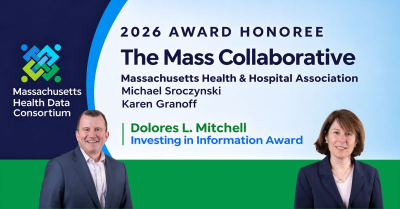
The Massachusetts Health Data Consortium (MHDC) will present the Mass Collaborative with its 2026 Dolores L. Mitchell Investing in Information Award.
As part of the award, MHDC will also recognize four participating organizations whose leadership and sustained engagement have helped advance the Collaborative’s work: MHA, the Massachusetts Medical Society, the Massachusetts Association of Health Plans, and Blue Cross Blue Shield of Massachusetts.
MHDC will also award the individuals who have advanced this work on behalf of those organizations. For MHA, Interim President and CEO Mike Sroczynski, and Senior Director of Payer Relations and Managed Care Policy Karen Granoff will be honored by MHDC. The awards will be presented at MHDC’s Annual Meeting and Awards Luncheon in December.
The Mass Collaborative is a voluntary partnership of health plans, providers, and trade associations focused on increasing efficiency, eliminating waste, and promoting greater standardization in healthcare administration. Its work has addressed areas such as provider credentialing, eligibility verification, claims review and appeals, prior authorization, provider information changes, and payer-provider communications. It has grown to include more than 35 organizations.
State Releases Funding Opportunities for Rural Tech Programs
Last week, the Massachusetts Technology Collaborative, through its Mass. eHealth Institute, issued notices of funding opportunity for three rural technology programs funded through the commonwealth’s Rural Health Transformation Program.
The first request for proposals (RFP) seeks applicants for the Rural Stronger & Healthier Communities through Integration of Emerging Health Tech Program or “Rural SHINE-HT.” The program will support the adoption and implementation of innovative health technology solutions designed to improve care delivery, strengthen workforce capacity, reduce administrative burden, and improve access to care in rural communities across the commonwealth. Responses are due to the RFP by December 11.
The second RFP seeks applicants for the Rural Health Cybersecurity Grant Program through which rural health facilities can receive grants to fund cybersecurity services, which include assessments, as well as managed detection and response. Responses to this RFP will be accepted on a rolling basis.
The third RFP seeks applicants for the Rural Digital Health Sandbox Program, which supports companies looking to test and validate new products and services within an authorized sandbox environment. (“Sandbox” in the tech world refers to an isolated testing environment or temporary safe space where software, code, or business ideas can run and be tested without affecting live systems, real users, or standard rules.) Proposed projects must demonstrate a clear focus on improving healthcare access, quality, and clinical outcomes in rural communities across Massachusetts. Grants of up to $475,000 are available. Responses to the RFP are due December 11.
DPH Issues Clarification on mPox Tests
The Massachusetts Department of Public Health (DPH) last week sent out a notice to providers cautioning them to be careful when interpreting mpox test results from commercial labs. DPH says it has noticed that some labs are reporting back on the samples they receive with two seemingly contradictory messages: “Orthopoxvirus DNA detected” as well as “Monkeypox virus DNA not detected.”
DPH says the only known orthopoxvirus currently circulating is, in fact, mpox. So to say an orthopox is detected but mpox is not doesn’t make sense. What more than likely occurred, DPH says, is that some commercial lab assays pick up one genetic variant of mpox (Clade II) but not the other (Clade I). So if a provider gets a conflicting test result back from a lab “this combination of results should be interpreted as likely Clade I mpox and the patient should be managed accordingly,” DPH writes.
The clarification is needed, DPH adds, because “clade I mpox is now spreading in the United States, including Massachusetts, and cases may occur in patients without a history of recent travel or contact with travelers [DPH added stress]. Previous data from endemic countries in Africa suggested that clade I was associated with more severe disease. However, in the US, clade I and II disease appear to be similar clinically causing mostly mild-to-moderate disease in patients who are not immunocompromised.”