

 Massachusetts Health & Hospital Association
INSIDE THE ISSUE
> Healthcare Affordability
> Flu, COVID-19, RSV
> Rural Health Funding
> Workplace Violence Summit
> Military-to-Medicine Pilot
MONDAY REPORT
Hospital Employers Feel Cost, Affordability Crunch
Healthcare affordability is worsening in the state, according to recent analysis from the state’s Health Policy Commission (HPC), but the methods to alleviate the problem are much less clear as was reflected in testimony given at the HPC’s latest cost trends hearing last Tuesday in Boston.
The HPC presented data showing that the average cost of healthcare for a Massachusetts family, including out-of-pocket spending, exceeded $34,000 in 2025 or $2,846 per month. Family health insurance premiums in Massachusetts have grown from $7,000 per year in 2000 to nearly $30,000 in 2025, according to the HPC.
The state’s healthcare system is poised to experience even more turmoil in the coming months. As a result of federal changes, more than 250,000 people in Massachusetts are expected to lose their coverage, beginning on January 1. That will place even more pressure on the already underfunded and overburdened Health Safety Net fund, which in turn will place more pressure on commercial premiums. Other supports to the system – state directed payments and the 340B drug program’s benefits to hospitals – are also being undermined, leaving $2.3 billion at risk by 2030. All this is occurring while many hospitals are experiencing negative or barely existent operating margins and as hospitals’ patient care expenses have risen by 54% over just four years, according to MHA’s new “Critical Condition” report.
While the cost trends discussions were wide ranging, one panel focused on how the current affordability crisis is affecting hospitals and community health centers. Peter Banko, president and CEO, Baystate Health; Alastair Bell, M.D., president and CEO, Boston Medical Center Health System; Brenda Rodriguez, CEO, Lynn Community Health Center; and Ryan Schwarz, M.D., Massachusetts’ Medicaid director and assistant secretary for MassHealth testified on a panel entitled A Sustainable Safety Net: Focus on Access, Coverage, and Equity.
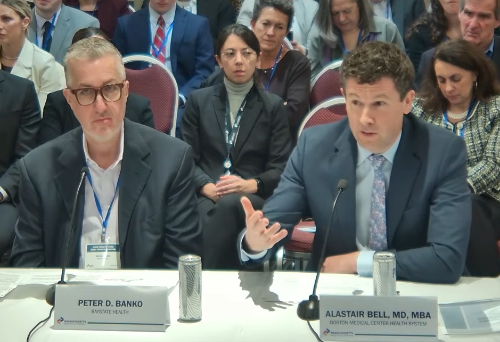
“In Western Mass in particular, demographics, our geography, where we cover urban, suburban, and rural populations, 70% of our payer mix is Medicare and Medicaid that do not reimburse our costs,” Banko said, adding that “the biggest structural threat to our system in Massachusetts is price adequacy – and affordability and price adequacy are not opposing objectives.”
Banko noted that his hospital system and others are the biggest employers in Western Massachusetts. And while Baystate has its own health plan and works to contain its own costs, it too is affected by inevitable premium increases. He said that if Baystate’s health plan were to counter low reimbursements from public payers by drastically raising commercial premiums it would in effect be raising the costs on itself.
BMC’s Bell suggested that the ills of the entire Massachusetts health system are intertwined. State budget pressures lead to low Medicaid reimbursements. Rising pharmaceutical costs are making it even more important to sustain the 340B program as drugs become increasing unaffordable. (MHA and local insurers have been very vocal in their advocacy against the state’s plan to carve out 340B from the Medicaid program.)
“So it’s a very conflicted conversation and all of that happens while we continue to see our core input costs, labor and supplies, go up dramatically,” Bell said. “Yet all of our organizations will work year in and year out on performance improvement, trying to do better for patients, trying to deliver more equitable care, trying to maintain access, trying to do all that in a cost model that is increasingly under strain.”
In offering a suggestion for what to do going forward, Bell noted that the upcoming Section 1115 waiver negotiations between Massachusetts and the federal government are extraordinarily important.
“What happens in the safety net part of the ecosystem ripples through the rest of the healthcare economy because where you have underfunding in that area, providers then start looking into other areas like the commercial sector to try to get some type of cross-subsidy to actually help with maintaining themselves,” Bell said. “And I think part of the answer is what are we doing in the next 1115 waiver? How are we maximizing the funding coming into the state? But also, how are we looking at how we set up payment structures to protect safety net providers and provide them a model where they can continue to innovate as we have done throughout our history to deliver better, more equitable care to our patients?”
HPC Commissioner Steve Walsh, the president and CEO of the American Hospital Association, noted the threatened revenue “hole fillers” previously discussed at the hearing – state directed payments, 340B, supplemental funding programs, support through the waiver, site neutral payments, etc. “What would happen if all of those went away?” Walsh asked the hospital CEOs. “Are you in business or out of business?”
“We’re out of business,” Bell said.
During the hearing’s close-out panel, Merrimack Health President and CEO Diana Richardson also made the case for stabilizing safety net care as a cost-reduction and access necessity. Merrimack earns $27 for standard mammogram screenings from its “best payer” but loses $100 when the service is covered by Medicare and $77 when Medicaid is the payer. Because three quarters of the system’s patients are on public insurance, even top commercial rates would not close the payment gap, Richardson said, adding that this type of dynamic drives tough decision-making for hospital leaders.
“As we frame all of these conversations, we have to start by stabilizing the safety net,” she said.
A Simple Shot Cures Many Healthcare System Ills
While the Massachusetts healthcare system as a whole grapples with the big questions surrounding affordability and cost control, a relatively simple solution exists to ease the hospital capacity crunch, cutdown on caregiver burnout, reduce avoidable care and emergency department overuse, and, by doing so, drive down overall costs. That solution is: vaccinate people against respiratory disease.
The state’s respiratory illness dashboard shows that while overall incidents of acute respiratory diseases (flu, COVID-19, and RSV) are “low” in the state, incidences of flu are much higher than at this time in previous years. By early November in previous flu seasons, there were about 100-140 patients in hospital EDs due to influenza. This year there are 1,300 or more, according to the state. And anecdotal information that member hospitals have provided to MHA indicates that some facilities already are “swamped” with flu cases in their EDs.
Last week, MHA, DPH, the Massachusetts Medical Society, and the Massachusetts Senior Care Association sent this letter to providers asking for their partnership in “promoting, encouraging, and facilitating vaccination” for their staff, communities, and patients.
The three vaccines that are readily available are proven to protect against, or lessen the consequences of, influenza, COVID-19, and RSV. And these vaccination measures are proven to reduce the burden of respiratory disease on hospital capacity.
Round Two of Rural Health Funding Flows to State
The second round of funding through the federal Rural Health Transformation Program (RHTP) was announced last week, with Massachusetts set to receive $158.4 million. The federal RHTP program is funded through a $50 billion appropriation in the One Big Beautiful Bill Act. The Centers for Medicare and Medicaid Services is distributing $10 billion annually to states over the next five years.
In the first year of funding, Massachusetts received $162 million. After the state application process for that funding ended last week, the programming is scheduled to begin at state’s six designated rural hospitals as well as at a host of other rural-focused entities, such as rural health clinics, rural-located nursing facilities, and physician practices in rural communities. The six designated rural hospitals in Massachusetts are Athol Hospital, Martha’s Vineyard Hospital, Fairview Hospital, North Adams Regional Hospital, Nantucket Cottage Hospital, and Baystate Wing Hospital.
CMS noted that the 2.2% decrease in funding to Massachusetts between year one and two of the program is not a reflection of the commonwealth’s performance but is more due to technical details such as changes to rural populations and facility characteristics. CMS also states that a one-year decrease does not determine a state’s trajectory for years three through five.
RHTP funds are distributed within Massachusetts through the Executive Office of Health & Human Services. MHA has advocated that the federal funding be distributed to a wider range of hospitals – that is, to all hospitals that serve rural communities but that might not be defined as “rural” by the state. As the state’s Office of Rural Health itself states: “There is no single definition of Rural.”
Leaders Gather to Discuss Healthcare Violence as Bill Pends
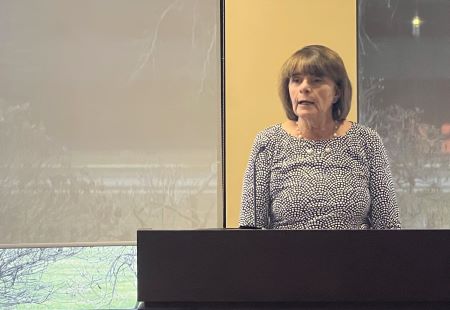
More than 120 people attended MHA’s Healthcare Safety & Violence Prevention Summit last Thursday to discuss the necessary but oftentimes difficult ways to protect caregivers and patients, who often find themselves in extraordinarily stressful situations. The full-day discussions focused on how the design of spaces can offer protection, safety issues encountered in home-based care, how to debrief patients and staff following a violent incident, and the role of hospital police departments – among many other discussion points. The District Attorney for Middlesex County for the past 13 years, Marian Ryan (in photo at right), delivered the morning address to attendees and participated in a panel entitled From Incident to Justice: Navigating the Legal Response to Violence Against Healthcare Workers.
Ryan is a strong advocate for passage of the healthcare worker violence prevention legislation now pending in a conference committee at the State House. After more than a decade of offering competing bills, MHA, the Massachusetts Nurses Association, and SEIU1199 united this legislative session to endorse the bill that the House and Senate passed in slightly different forms. While it is unclear if a compromise will be reached before the session ends, Ryan expressed hope that a deal would be reached in time to allow Governor Healey to sign the sorely needed law.
Administration Proposes “Military-to-Medicine” Pilot
At the November 10 Public Health Council meeting, the Healey-Driscoll administration proposed a Military-to-Medicine pilot program that would help veterans transition into healthcare careers at hospitals.
If the proposed regulations are enacted, they would allow a limited number of eligible veterans who previously served as military medics to perform certain medication administration activities at approved Massachusetts hospitals.
“Military medics have some of the most extensive training and experience in healthcare, often serving under incredibly challenging circumstances,” Governor Maura Healey said in a news release announcing the pilot. “But when they return home, too many face barriers to putting those skills to work. This program will create new career opportunities for veterans while supporting the hospitals and patients who can benefit from their skills and expertise.”
The pilot program would be for 10 eligible veterans at participating DPH-licensed hospitals, subject to DPH approval. The Executive Office of Veterans Services would evaluate the program to assess how military medical experience can translate into civilian healthcare opportunities and help hospitals recruit and retain veterans who are skilled workers.