

 Massachusetts Health & Hospital Association
INSIDE THE ISSUE
> State Announces Outreach Effort
> New Finance Series: 340B
> Kratom Crackdown
> Save the Date for CARe Forum
MONDAY REPORT
OB3’s Effect on Coverage and the Safety Net
The massive effort to ensure that hundreds of thousands of Massachusetts residents do not lose their health insurance coverage kicked into a higher gear last week as Governor Maura Healey formally announced an outreach and education strategy to reach affected MassHealth enrollees.
Changes to eligibility for certain immigrants will begin in October and are expected to result in coverage losses for that population. Beginning January 1, approximately 360,000 MassHealth enrollees will be required to work or pursue other approved activities for a certain number of hours per month to be eligible for benefits, unless they have an exemption such as being pregnant or having a complex medical condition. Also, many people will have to re-enroll into MassHealth every six months as opposed to annually under the new, stringent Medicaid rules contained in the One Big Beautiful Bill Act (OB3).
Reaching the affected people across Massachusetts will be difficult. It will require the emails, phone numbers, and addresses of individuals in the MassHealth system to be up to date. Enrollees must sort out the official mailings they receive from the junk mail in their mailboxes. They’ll have to listen to robocalls from the state as opposed to deleting them, and they’ll need some form of computer literacy to use the online tools the state is creating. To handle the administrative burden, the legislature appropriated $10 million to assist the outreach lead – Health Care For All – which will be working with 50 community partners. The state has rolled out a series of outreach resources through a centralized webpage.
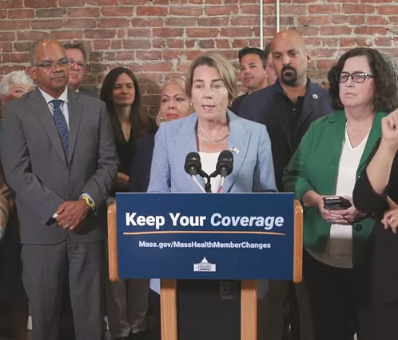
“As the Trump administration works to prevent Americans from enrolling in Medicaid in order to finance their tax cuts for the wealthy, this statewide public awareness campaign is representative of the commonwealth’s commitment to ensuring that eligible Massachusetts residents are able to navigate the new Medicaid requirements and keep their coverage,” said House Speaker Ronald J. Mariano (D-Quincy).
The potential coverage losses are not just of concern to the affected patients. As Governor Healey said at the press conference last week in Haverhill, “It’s going to hurt our hospitals. It’s actually going to hurt everybody because people are going to continue to need care even if they don’t have health insurance. They’re going to go to the hospital and the hospital is going to have to provide that care. And then the cost of that care is going to get passed back to all of us in the form of higher healthcare premiums – and none of us can afford healthcare premiums going up anymore.”
Reimbursement to hospitals for providing care to people who are uninsured comes through the Health Safety Net (HSN) fund, which is projected to run another substantial deficit this fiscal year – $190 million, even after $100 million in state relief and before factoring in the newly uninsured who will lose coverage beginning in 2027. According to the Massachusetts Taxpayers Foundation, the Medicaid coverage changes alone will more than double the number of uninsured individuals in the state and increase HSN demand by up to $510 million – a figure that aligns closely with MHA’s and the state’s estimates. Shortfalls in the fund are borne by hospitals alone. That is, hospitals “eat the bad debt” from Health Safety Net underfunding, which contributes to 70% of Massachusetts hospital systems having negative operating margins.
“As trusted voices for their communities, our hospitals and health systems are proud to be a partner in the commonwealth’s push to connect people with the healthcare coverage and resources they need, said Michael Sroczynski, MHA’s general counsel and incoming interim president and CEO. “This is, first and foremost, an imperative effort to maintain patients’ access to care – but it is also critical for the stability of our healthcare system as a whole, which is already feeling the effects of a strained Health Safety Net. We look forward to supporting and amplifying the state’s efforts as these changes approach.”
Connecting the Symptoms Series: The Erosion of 340B
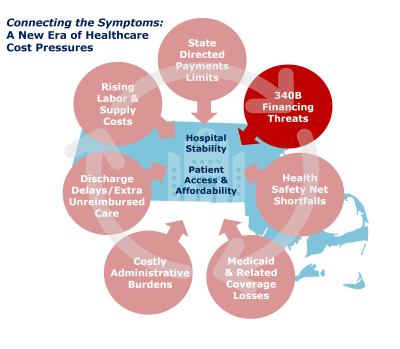
A caregiver assessing a patient usually looks beyond a single condition or symptom to address the person’s physical, mental, social, and emotional wellbeing. They treat the entire person. Now, as the state and diverse stakeholders attempt to improve the Massachusetts healthcare system to make it more stable and affordable, it becomes critical to look at the complete – and quickly evolving – spectrum of challenges facing hospitals and health systems.
The enactment of OB3, anticipated reductions in State Directed Payments, new federal constraints on Medicaid financing mechanisms, changes to Section 1115 budget neutrality requirements, the expected loss of health coverage for hundreds of thousands of Massachusetts residents, steadily increasing supply and labor costs, and threats to 340B financing collectively represent the most significant assault on healthcare financing in history. The cumulative effect of each financial condition, some of which have yet to be explored in the public eye, will leave billions of dollars hanging in the balance for the healthcare system in the coming years, and will ultimately affect care for Massachusetts residents. Over the coming weeks, Monday Report will continue to explore various parts of the collective financial whole. Read part one here, covering State Directed Payment limits.
Threats to an Essential Lifeline: 340B
The federal 340B Drug Pricing Program has existed for 34 years and has become such an essential lifeline for the day-to-day operation of safety net hospitals and health systems that the recent attacks on it by pharmaceutical companies – as well as erosive policies from state and federal government – are of great concern to providers.
Under 340B, hospitals are allowed to buy outpatient medications directly from pharmaceutical companies at deep discounts (ranging from 20% to 50% off) and these savings have become embedded throughout hospital services and their communities. Given constraints with reimbursements from public and commercial insurers, 340B savings provide a necessary financing source for hospitals to support the growing expenses associated with serving patients. Hospitals rely upon these resources to sustain essential service lines, expand access to pharmacy services, support workforce investments, and finance numerous activities that benefit MassHealth members and other patients. Without 340B, these hospital programs would operate at a loss.
The 340B discounts are drawn solely from pharmaceutical profits and have become instrumental for safety net providers, especially as they operate on shrinking margins and brace for a new era of cost constraints in the near future. Hospitals have spoken first-hand about the services 340B allows them to deliver and the troubling consequences that would result from cutbacks to the program.
In Massachusetts, the state has been steadily chipping away at how 340B entities – hospitals, health systems, community health centers – can benefit from the federal program. In 2020, MassHealth carved out 25 high-cost drugs from MassHealth program, prohibiting coverage of these drugs if purchased using the 340B discount. Then in 2024, MassHealth instructed its managed care plans not to reimburse certain weight loss drugs prescribed to MassHealth members if the drugs were purchased through the 340B program. And this July, MassHealth fully carved-out all 340B drugs in its fee-for-service program despite significant opposition from MHA, community health centers, and other provider groups. MHA and the Mass. League of Community Health Centers recently urged legislative leaders to issue a one-year moratorium on the controversial carve-out policy.
Now, MassHealth is considering further changes that would affect hospital 340B financing. The state is currently considering changes to how pharmacy benefits are covered in its managed care programs, including a proposal that would carve-out 340B drugs for this population as well. Such a change would have devastating financial consequences for many safety net hospitals. To offset this financial loss, the state is considering pursuing a provision in its upcoming 1115 waiver renewal to establish a new funding program for hospitals in lieu of 340B financing for retail prescription drugs.
In its recent communications with the state, MHA has once again stressed that its membership is against any Medicaid 340B carve-out or any financing strategy that is conditioned on hospitals relinquishing their existing 340B benefits. Given the uncertainty of consistent state financing – dependent on legislative appropriations, economic fluctuations, and other ever-changing variables – such supplemental payments introduce more risk into the system. Such an approach would also merely substitute one financing mechanism for another while introducing uncertainty, MHA argues. And devoting substantial waiver authority towards the replacement of existing hospital financing would reduce the commonwealth’s ability to pursue other needed investments through the waiver that will be required to mitigate the immense financial losses related to upcoming federal Medicaid changes.
At the federal level, some in Congress and the administration are moving ahead on a 340B drug rebate plan that would replace immediate upfront discounts with an after-the-fact reimbursement process. Hospitals would pay full list prices upfront, wait for manufacturer approvals, and then spend significant resources managing complex data claims, tech systems, and payment denials to eventually get their statutory discounts. A previous iteration of the rebate plan from the Health Resources and Services Administration (HRSA) was struck down by a federal court in December 2025; HRSA returned with a revised rebate plan this month that still contains the main elements of concern from the provider community – namely, hospitals are being instructed to finance drug purchases upfront while relying on drug manufacturers to voluntarily return the statutorily-owed discount after the fact.
“340B is exactly the type of solution we need to be embracing – not eroding – at this time,” said Dan McHale, MHA’s senior vice president for healthcare finance and policy. “340B savings help hospitals and community health centers keep care services afloat and reach underserved neighborhoods across the commonwealth. These are not excess revenues that can comparably be replaced through an alternative Medicaid payment methodology. They are integral to hospitals’ ability to fulfill their mission and cannot be risked – much less at this critical turning point for the provider community.”
Massachusetts Cracks Down on Drug Sold through Gas Stations

Declaring that the drug kratom is “an imminent hazard to the public safety,” the Massachusetts Department of Public Health (DPH) last Thursday issued an executive order stating that all forms of kratom will be considered a Schedule I drug under state law. The designation goes into effect on August 28 and will remain in effect for one year. During that time, any food, retail or other commercial establishment possessing or distributing kratom could have their license or permission to operate revoked.
Schedule I drugs are those that have a high potential for abuse and no currently accepted medical use in treatment. Among other Schedule I drugs are heroin, LSD, MDMA/ecstasy, and mescaline.
Kratom is a plant native to Southeast Asia. Its use can produce stimulant-like effects or it can be a sedative – all dependent on the amount consumed. It is distributed in a natural form or synthetic form and because it is not regulated, consumers have no idea about its purity, potency, or the compounds it may contain.
Kratom products are sold widely through gas stations, convenience stores, smoke shops, and other locations.
“Since 2020, there have been approximately 100 deaths reported in Massachusetts to be associated with kratom or related substances,” DPH wrote in a note accompanying the order. “Deaths may be underreported as no ICD codes (clinical modification for diagnosis coding in U.S. healthcare settings) currently relate to kratom or related substances. From July 2025 through July 28, 2026, the Electronic Surveillance System for the Early Notification of Community-Based Epidemics (ESSENCE) has records of 314 visits in MA where kratom was mentioned in either the ‘triage notes’ or ‘chief complaint’ field.”
New Date for Annual CARe Forum
The 12th Annual Communication, Apology and Resolution (CARe) Forum will now occur on Friday, November 6, from 9:30 a.m. to 12:30 p.m. It will feature keynote speaker Leilani Schweitzer, former assistant vice president for communication and resolution programs at Stanford Health Care and lead instructor for Comm Corps. The forum will also include interactive simulations and panel discussions on CARe implementation. Registration will open in the coming weeks for this free, in-person event that will include lunch and networking. For those who are unable to attend in-person, there will be an option to join virtually. For more information, contact Melinda Van Niel, CARe program director, at Melinda.VanNiel@BetsyLehmanCenterMA.gov.