

 Massachusetts Health & Hospital Association
INSIDE THE ISSUE
> State House Rally
> MassHealth’s 340B Policy
> Behavioral Health Dashboard
> Schwartz Center Dinner
MONDAY REPORT
Caregivers Rally at State House for Violence Prevention Law
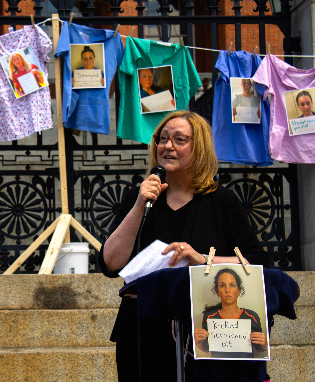
Nurses, caregiver advocates, and healthcare unions held a rally on the State House’s steps last Wednesday to draw attention to the urgent need to pass a violence prevention bill before the end of the current legislative session on July 31.
Standing before a line of 40 scrub tops, each representing a healthcare worker harmed during their shift at a Massachusetts hospital over the course of one day, the speakers spoke of the lasting harm that workplace violence inflicts on committed caregivers.

“These people are threatened, spat on, kicked, punched, verbally abused, stabbed, and countless other terrorist acts,” said Karen Coughlin, R.N., a member of the Massachusetts Nurses Association’s (MNA’s) Board of Directors and Workplace Violence and Abuse Prevention Task Force. “This has become so commonplace that it is often accepted by many as part of the job. But it is not. No one should have to accept violence as a condition of employment.”
The groups are urging the Senate to pass H.4767, An Act Requiring Healthcare Employers to Develop and Implement Programs to Prevent Workplace Violence, which is currently before the Senate Ways & Means Committee after the House unanimously passed the measure this session. The bill came about after more than a decade of competing but similar proposals were put aside and a unifying agreement was reached between MHA, the MNA, and 1199SEIU Massachusetts. Representatives from the Massachusetts Emergency Nurses Association and Massachusetts College of Emergency Physicians also spoke at the event in support of the legislation. (A full recording of the rally is here.)
The bill requires all hospitals to complete facility-specific risk assessments and implement comprehensive violence prevention programs tailored to those findings; and engage frontline staff in developing assessments and prevention plans, ensuring workforce-informed training, and making written plans available to all employees and labor organizations.
The bill strengthens enforcement through DPH licensing requirements, regular reporting, and enhanced job protections for workers, including additional paid leave for employees who are assaulted.
Christi Barney, R,N., the vice president quality and patient safety, chief health equity officer at Emerson Hospital, and the co-chair with the Lahey Clinic’s Brendan Riley of MHA’s Healthcare Safety & Violence Prevention Workgroup, spoke of MHA’s survey that found that every 36 minutes a healthcare worker in Massachusetts experiences violence.
“We greet patients with compassion,” she said. “It is our wish to take care of every single person who comes through the door. We wrestle with issues of equity and of access and wanting to make sure that we’re really seeing people for who they are and meeting them where they’re at. But sadly, many of our co-workers had career-ending injuries in the course of trying to provide that compassionate care. We’re urging the Senate, please move forward. Bring this to conclusion in this legislative session.”
MassHealth Moving Ahead with Controversial 340B Policy
The state is moving ahead – inappropriately, MHA claims, without the required 180-days’ notice and economic impact analysis – with a plan that will impose even more financial instability on hospitals that rely on the 340B drug discount program.
On April 10, MassHealth proposed regulatory changes to pharmacy benefits in the MassHealth program, saying it would no longer reimburse for drugs that were bought through the federal 340B Drug Pricing Program if they are submitted via a pharmacy’s point-of-sale retail billing system. MassHealth further clarified that the changes would only apply to point of sales for those enrolled in MassHealth fee-for-service, although MHA and others have flagged that the proposed regulations are drafted in a manner that permits a wider carve-out than the proposal indicates. As much as 46% of the MassHealth population would be affected, MHA has determined.
On May 1, MassHealth held a public hearing where MHA and other organizations voiced concerns with the proposal, saying that even if the policy is limited to fee-for-service, many hospitals that care for large populations of uninsured and low-income patients will be financially worse off given that MassHealth will, in most instances, reimburse those hospitals less than the cost of acquiring the prescriptions drugs that they dispense to patients. Increased administrative burden was also cited as a concern, given providers will be required to manage different pharmacy inventories for the MassHealth program depending on fee-for-service and managed care enrollment.
Also of concern, MHA stressed to MassHealth, is that state law requires that hospitals be given 180-days’ notice when 340B access is limited. And that same law (Chapter 118E) requires the state to conduct a report on the estimated savings to the commonwealth and the estimated fiscal impact on each affected hospital, as well as the manner in which the state plans to mitigate the fiscal impact. The Executive Office of Health and Human Services asserts that the requirements of the law do not apply in the current case.
“Despite the strong concerns of our membership, and in the well-known financial troubles still to be borne by hospitals due to the One Big Beautiful Bill Act, the state unfortunately has given no indication that it will delay implementation of this problematic policy,” said Dan McHale, MHA’s senior vice president of healthcare finance and policy. He called on MassHealth to delay proceeding with the policy and for the agency to conduct a more robust fiscal impact analysis that includes engagement with 340B entities.
CHIA Releases Updated Behavioral Health Dashboard
The Center for Health Information and Analysis (CHIA) has released an updated behavioral health dashboard that contains indicators of behavioral health access, finance, use, quality, and equity.
Among other data points, CHIA’s report shows that behavioral health emergency department visits declined 5% in 2025. And in 2025, 8.7% of behavioral health needs went unmet because of the cost for families, and 5.4% went unmet for individuals. In 2024, behavioral health services represented 8.1% of commercial, 22.4% of MassHealth, and 2.3% of Medicare Advantage healthcare spending.
While suicide deaths per 100,000 residents remained fairly similar from 2022 to 2024, alcohol-induced deaths, drug overdose deaths, tobacco use, and heavy drinking all declined during that same period. More than a quarter of Metro Boston residents reported that they had a visit for behavioral healthcare or treatment in 2025, higher than any other region.
CHIA’s publication was also accompanied by an interactive Tableau dashboard.
The Annual Schwartz Center Compassionate Healthcare Dinner
Save the date – Tuesday, October 27 at 5:30 p.m. – for the annual Kenneth B. Schwartz Compassionate Healthcare Dinner at the Westin Seaport, Boston. The dinner is the main fundraiser for the center and is also when the annual Schwartz Compassionate Caregiver Award is presented. Individual tickets are $550. Learn more here.